[Eds. note: This is the 12th of 14 runner-up posts from the recent Kauai on My Mind Creative Competition.]
by Carrie Rautmann
Kolea sees the rising of Orion's Belt,
And follows the belt
Into Dawn's day.
He spent his winter
On green pastures of Kauai
Nourished by rain waters
Which have fallen from
Wai'ale ale to swell into rivers and land.
Plumage changes, reminding him
Of his return to the Alaskan tundra.
How can he know this path
Of 3,000 miles across ocean
To ancient nesting grounds
His grandmother has used?
What faith does he need
To ride through currents of air
Across vast waters
To reach land?
He arrives in open tundra,
And finds his feathered
Brothers and sisters.
Seeking his mate,
They find each other
Build their nest.
Eggs laid, they wait patiently.
Hatching, the young ones
Feed well, and grow strong
For the journey home.
They watch the sky,
For the sign to return.
Some seekers who have
Called him papakolea
Follow him now in double hulled
Canoes, praying to the night sky
While papakolea listens for the
Whisper of the dragon thrashing
Across dark skies.
In the middle of the ocean
He rides on dragon's breath
To find a pasture on an island
Where he had fed a year ago.
Paddling canoes
Tracing after stardust from papakolea,
They reach the shores
And reunite to land.
In this way,
Seabirds and seekers
Find reunion.
Thursday, November 30, 2006


Wednesday, November 29, 2006
Morning Dew
[Eds. note: This is the eleventh of 14 runner-up posts from the recent Kauai on My Mind Creative Competition.]
by Carrie Rautmann
Taro leaf cradles morning dew
Sunlight scattering
Silver tones into garden patch
Casting notions of fertility
And vitality into day.
Outward bound,
Yet held in pregnant pause,
Female water,
Round and full upon leaf,
Speaks of muted heart shape green
And ancient purple lineage
Of Mother taro.
How can one drop be held
In such Reverent Suspension?
Separate, yet offered as gift
In a hungry moment
To thirsty tongues who may drink
From this leaf,
Or to the wind, who may
Cast this water onto Earth in one shake.
What journey can this dew drop begin?
And inside the light of Dawn
Streams onto the faces
Of Two who have woven in embrace.
One drop of Essence reaches egg.
In female waters,
Life begins in womb,
Eggs multiplying again and again.
Innocence, born from Passion,
Becomes alive from this Union
And outside, the morning dew
Dances its belly dance
Upon leaf, like a heartbeat
Drumming itself into life,
And when the drop falls to Earth,
It innocently begins
The journey again,
Drinking upon Earth,
To river to ocean to cloud,
To fall to Earth again, and
Again, and again and again.
by Carrie Rautmann
Taro leaf cradles morning dew
Sunlight scattering
Silver tones into garden patch
Casting notions of fertility
And vitality into day.
Outward bound,
Yet held in pregnant pause,
Female water,
Round and full upon leaf,
Speaks of muted heart shape green
And ancient purple lineage
Of Mother taro.
How can one drop be held
In such Reverent Suspension?
Separate, yet offered as gift
In a hungry moment
To thirsty tongues who may drink
From this leaf,
Or to the wind, who may
Cast this water onto Earth in one shake.
What journey can this dew drop begin?
And inside the light of Dawn
Streams onto the faces
Of Two who have woven in embrace.
One drop of Essence reaches egg.
In female waters,
Life begins in womb,
Eggs multiplying again and again.
Innocence, born from Passion,
Becomes alive from this Union
And outside, the morning dew
Dances its belly dance
Upon leaf, like a heartbeat
Drumming itself into life,
And when the drop falls to Earth,
It innocently begins
The journey again,
Drinking upon Earth,
To river to ocean to cloud,
To fall to Earth again, and
Again, and again and again.
Tuesday, November 28, 2006
The Blessing
[Eds. note: This is the tenth of 14 runner-up posts from the recent Kauai on My Mind Creative Competition.]
by Rocky Riedel
A rock spoke to me. It was in the stream up there in Kapahi, at the little bridge near the end of the road. I was leaning over the white wooden railing, watching the water glisten as it danced down the stream. The water and I were both reflecting.
I was there for a while when a rock, its nose jutting up just above the happy water, started speaking to me. I could barely see its mouth but it was definitely gurgling and burbling, asking me to listen as the water washed over its face.
I can’t repeat what it said because it didn’t use specific words. It was more as if crystal droplets of language leapt from the rock’s lips, landed on my skin and soaked straight through to my heart. Suddenly full of unspeakable knowing, my heart brimmed over. Grace anointed my very soul like a rich soothing oil.
I don’t remember how much time passed and I don’t remember what I was thinking or if people walked by or even if it rained. I can only tell you this: I was healed and I was loved.
After a while I knew it was time for me to leave. I bowed low to the rock, humbly thanking it for its glorious blessing. And then I crossed the bridge to the other side.
by Rocky Riedel
A rock spoke to me. It was in the stream up there in Kapahi, at the little bridge near the end of the road. I was leaning over the white wooden railing, watching the water glisten as it danced down the stream. The water and I were both reflecting.
I was there for a while when a rock, its nose jutting up just above the happy water, started speaking to me. I could barely see its mouth but it was definitely gurgling and burbling, asking me to listen as the water washed over its face.
I can’t repeat what it said because it didn’t use specific words. It was more as if crystal droplets of language leapt from the rock’s lips, landed on my skin and soaked straight through to my heart. Suddenly full of unspeakable knowing, my heart brimmed over. Grace anointed my very soul like a rich soothing oil.
I don’t remember how much time passed and I don’t remember what I was thinking or if people walked by or even if it rained. I can only tell you this: I was healed and I was loved.
After a while I knew it was time for me to leave. I bowed low to the rock, humbly thanking it for its glorious blessing. And then I crossed the bridge to the other side.
Monday, November 27, 2006
Returning To My Island Home
[Eds. note: This is the ninth of 14 runner-up posts from the recent Kauai on My Mind Creative Competition.]
by Coral Miles
Longings soon to be fulfilled
Doors fall open, my heart leaps,
Inhaling deeply, memories awake
Sweet fragrance fills the air
But then, other odors linger there
Chant: Welcoming home… Welcoming home…
Welcoming home…
Seeking again visions of my youth
Waking to compelling truth
Quiet retreats, unfilled shore
Once were mine, but now no more
Chant: Searchin’… Searchin’… Searchin’…
Searchin’… Searchin’… Searchin’…
Crawling traffic, multiplied lights
Why can’t I see the stars at night?
Crossing fields, traversing lanes
Finding barred with fence and chains
Chant: Kapu, Keep-out… Kapu, Keep-out…
Kapu, Keep-out…
We must gain we must prosper
Keep it coming, growing faster
Pursuing hope in ancient places
Metal bird in air erases
Chant: Aloha compromising, another building rising… Aloha compromising, another building rising...
Youth with smiles, lilting laughter
Aunties, tutus, running after
Now empire feet and belly things
Beeping sounds and smoky rings
Chant: We like ta-ttoos… We like ta-ttoos… We
like ta-ttoos…
Once proudly worn your teeming reef
Now dying rock and crowded beach
Still the water warm and clear
The sun still warms my shoulders
Is it just that I am older?
Chant: Paddle hut… Paddle ho… Paddle hut…
Paddle ho…
Lei circling my neck, fast fading flowers
Regaining paradise, hope in measured hours
Though our island keeps on giving
Growth with pain, pain with living
Chant: Tourist in jeep... Tourist in jeep...
Tourist in jeep...
Returning to my island home
You and I have surely grown
Heaven’s touch still surrounds
Your velvet peaks, your radiant ocean
Inspiring our divine emotion
Chant: Terra healing, God revealing… Terra healing, God revealing…
Questioning what I must do
How can I give back to you?
A willing sacrifice I pledge
I will sow... I will seed
Endeavoring to fill the need
Strains of: “Aloha Oe”
by Coral Miles
Longings soon to be fulfilled
Doors fall open, my heart leaps,
Inhaling deeply, memories awake
Sweet fragrance fills the air
But then, other odors linger there
Chant: Welcoming home… Welcoming home…
Welcoming home…
Seeking again visions of my youth
Waking to compelling truth
Quiet retreats, unfilled shore
Once were mine, but now no more
Chant: Searchin’… Searchin’… Searchin’…
Searchin’… Searchin’… Searchin’…
Crawling traffic, multiplied lights
Why can’t I see the stars at night?
Crossing fields, traversing lanes
Finding barred with fence and chains
Chant: Kapu, Keep-out… Kapu, Keep-out…
Kapu, Keep-out…
We must gain we must prosper
Keep it coming, growing faster
Pursuing hope in ancient places
Metal bird in air erases
Chant: Aloha compromising, another building rising… Aloha compromising, another building rising...
Youth with smiles, lilting laughter
Aunties, tutus, running after
Now empire feet and belly things
Beeping sounds and smoky rings
Chant: We like ta-ttoos… We like ta-ttoos… We
like ta-ttoos…
Once proudly worn your teeming reef
Now dying rock and crowded beach
Still the water warm and clear
The sun still warms my shoulders
Is it just that I am older?
Chant: Paddle hut… Paddle ho… Paddle hut…
Paddle ho…
Lei circling my neck, fast fading flowers
Regaining paradise, hope in measured hours
Though our island keeps on giving
Growth with pain, pain with living
Chant: Tourist in jeep... Tourist in jeep...
Tourist in jeep...
Returning to my island home
You and I have surely grown
Heaven’s touch still surrounds
Your velvet peaks, your radiant ocean
Inspiring our divine emotion
Chant: Terra healing, God revealing… Terra healing, God revealing…
Questioning what I must do
How can I give back to you?
A willing sacrifice I pledge
I will sow... I will seed
Endeavoring to fill the need
Strains of: “Aloha Oe”
Sunday, November 26, 2006
Walking Trail
[Eds. note: This is the eighth of 14 runner-up posts from the recent Kauai on My Mind Creative Competition.]
by Charles Looney
It is a walking trail.
It offers
a lungful of plumeria air,
a chat with the broke winged nene,
a glimpse of heron blue predator
rippling the green lagoon waters
with wings to an island, an egg, a fish,
and silly white-masked Coots
or red-masked Moorhens
who talk like geese
who walk on tiny stilts
who want to but can’t be
ducks at all.
It is to be assaulted
with the usual machines
for the usual reasons.
Some will survive the
carbon monoxide
and the ripping of the earth.
Some will collapse
into history.
Some will linger
to remember,
a poison tree on a poison hill.
by Charles Looney
It is a walking trail.
It offers
a lungful of plumeria air,
a chat with the broke winged nene,
a glimpse of heron blue predator
rippling the green lagoon waters
with wings to an island, an egg, a fish,
and silly white-masked Coots
or red-masked Moorhens
who talk like geese
who walk on tiny stilts
who want to but can’t be
ducks at all.
It is to be assaulted
with the usual machines
for the usual reasons.
Some will survive the
carbon monoxide
and the ripping of the earth.
Some will collapse
into history.
Some will linger
to remember,
a poison tree on a poison hill.
Saturday, November 25, 2006
Wild Sea
[Eds. note: This is the seventh of 14 runner-up posts from the recent Kauai on My Mind Creative Competition.]
by Mary Hunter Leach
Surf is up! The wild sea is calling,
calling all who hear, calling even me (one who does not surf).
This is not a day to be indoors, to be contained,
I tell my friend. We must go out! And so we leave
our smaller, undone things, called by the wild sea.
How high they are, these waves--huge, unconquerable, salt-spraying waves--
crashing over lava rock and shoreline,
ten, no twenty feet high: glorious!
Breaking, spraying, breaking
again and again,
rhythm unseen, rhythm nevertheless.
Giant waves rush onto shore, take the beach that we know,
claiming the sand we stand on, loose branches, seaweed, so many shells.
All moves seaward, even the eyes of scattering tourists,
who find no resting places in the sun. Not today!
This is ocean, nothing less will rule!
We enter her, slowly at first, aware of danger.
Soon we are swimming out, rolling in, carried farther and farther out
each time, though we are still near shore.
I long to roll past all this, take the highest wave and soar,
but even our strongest strokes are no match
for ocean’s sweeping song.
I hear my fear, taste the salt of it, asking
how far into this wildness will I be thrown?
Will I return, still be alive?
No answer from the huge waves crashing, no
letting up, no stopping this wild sea. She is alive!
My friend’s gentle voice, laughing, relaxes me
until I become the water: I am the sea,
flowing in and out toward shore, trusting the unseen
rhythm, all that wildness flowing into
something I can bear.
Later that night, I still cannot contain myself.
I must see your face, must bring you this wild sea.
You are covered in duty, I interrupt you, yet you let me,
smiling. “I can smell it,” you say. You know the surf is up.
“Yes,” I say. I know you do, as I look at you,
calling to your own unseen wild seas.
I know you know the wild sea.
by Mary Hunter Leach
Surf is up! The wild sea is calling,
calling all who hear, calling even me (one who does not surf).
This is not a day to be indoors, to be contained,
I tell my friend. We must go out! And so we leave
our smaller, undone things, called by the wild sea.
How high they are, these waves--huge, unconquerable, salt-spraying waves--
crashing over lava rock and shoreline,
ten, no twenty feet high: glorious!
Breaking, spraying, breaking
again and again,
rhythm unseen, rhythm nevertheless.
Giant waves rush onto shore, take the beach that we know,
claiming the sand we stand on, loose branches, seaweed, so many shells.
All moves seaward, even the eyes of scattering tourists,
who find no resting places in the sun. Not today!
This is ocean, nothing less will rule!
We enter her, slowly at first, aware of danger.
Soon we are swimming out, rolling in, carried farther and farther out
each time, though we are still near shore.
I long to roll past all this, take the highest wave and soar,
but even our strongest strokes are no match
for ocean’s sweeping song.
I hear my fear, taste the salt of it, asking
how far into this wildness will I be thrown?
Will I return, still be alive?
No answer from the huge waves crashing, no
letting up, no stopping this wild sea. She is alive!
My friend’s gentle voice, laughing, relaxes me
until I become the water: I am the sea,
flowing in and out toward shore, trusting the unseen
rhythm, all that wildness flowing into
something I can bear.
Later that night, I still cannot contain myself.
I must see your face, must bring you this wild sea.
You are covered in duty, I interrupt you, yet you let me,
smiling. “I can smell it,” you say. You know the surf is up.
“Yes,” I say. I know you do, as I look at you,
calling to your own unseen wild seas.
I know you know the wild sea.
Friday, November 24, 2006
Makuahine
[Eds. note: This is the sixth of 14 runner-up posts from the recent Kauai on My Mind Creative Competition.]
by Kimberly Kirk
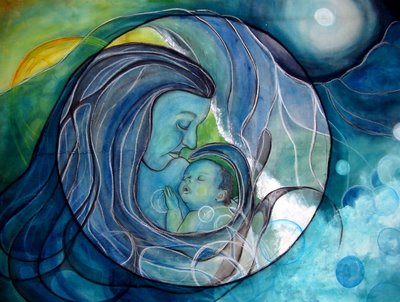
by Kimberly Kirk

Thursday, November 23, 2006
Surrender
[Eds. note: This is the fifth of 14 runner-up posts from the recent Kauai on My Mind Creative Competition.]
by Suzanna Kennedy
I surrender to the coconuts that fall unto my roof and wake me up at night
I surrender to the roosters that crow before dawn
I surrender to the mangos too numerous to harvest, that litter my yard, fermenting
I surrender to gecko poop on my furniture
I surrender to the mold that belies the moist salt air
I surrender to you, Kauai
You have stripped me naked of all
my armor and weapons
You’ve struck down my defenses against love
Defenses against vulnerability
Against intimacy
And authenticity
I’ve done battle with you, Kauai
Trying to keep your abundance at bay
To preserve my illusion of order
Trying to squeeze your love into shapes and
forms that where familiar
But why?
Those forms never worked for me anyway
Those forms were my prison
Why cling?
Why fight?
Why force and push?
Why labor at all?
I surrender to you, Kauai
You win
Go ahead and love me, anyway you want
by Suzanna Kennedy
I surrender to the coconuts that fall unto my roof and wake me up at night
I surrender to the roosters that crow before dawn
I surrender to the mangos too numerous to harvest, that litter my yard, fermenting
I surrender to gecko poop on my furniture
I surrender to the mold that belies the moist salt air
I surrender to you, Kauai
You have stripped me naked of all
my armor and weapons
You’ve struck down my defenses against love
Defenses against vulnerability
Against intimacy
And authenticity
I’ve done battle with you, Kauai
Trying to keep your abundance at bay
To preserve my illusion of order
Trying to squeeze your love into shapes and
forms that where familiar
But why?
Those forms never worked for me anyway
Those forms were my prison
Why cling?
Why fight?
Why force and push?
Why labor at all?
I surrender to you, Kauai
You win
Go ahead and love me, anyway you want
Wednesday, November 22, 2006
WE MOURN YOU, RAYMOND NAPOLEON
[Eds. note: This is the fourth of 14 runner-up posts from the recent Kauai on My Mind Creative Competition.]
C. 2005, Dawn Fraser Kawahara
By the heiau a cloud envelops me
obscuring the river, obscuring the sea,
a rainbow rises, shimmer bridge
from the Hundley Hill pines
to Kalepa ridge
and the plum trees
at the edge where Raymond took his life.
The road drops down to a leaden river,
a tarnished sea, how could it be
that he had had enough
at twenty-five. . .
His name in the roll book
ten years ago comes alive–
the boyish grin, intelligent eyes,
well liked, well grounded,
attends to his work, no trouble
even to a substitute.
After school we’d see him
hefting his golf bag,
power drive, two putts
topping his good short game--
Raymond Napoleon.
Met him again in Waipouli
friendly as ever
white apron wrapping his waist,
his family, he said, was fine.
And Raymond? Fine, just fine,
not much time for golf
working Aloha Diner.
Same grin–the likeable boy
now a likeable man.
On the way to golf
one summer afternoon
we saw a car parked
by the trees that cling to the ledge,
wondered who might have stopped
to look toward O`ahu,
nap on the heiau’s edge.
The next day’s obituary–shock!
as we remembered Raymond.
Later we learned
he’d looped the noose
on a branch of those same trees.
We lash ourselves, so unaware,
oblivious to his pain,
how could we pass so close to his last stand
unknowing, unable
to reach out, hold him
to the promise of his life,
stop our former student friend
from following his dead-end plan.
C. 2005, Dawn Fraser Kawahara
By the heiau a cloud envelops me
obscuring the river, obscuring the sea,
a rainbow rises, shimmer bridge
from the Hundley Hill pines
to Kalepa ridge
and the plum trees
at the edge where Raymond took his life.
The road drops down to a leaden river,
a tarnished sea, how could it be
that he had had enough
at twenty-five. . .
His name in the roll book
ten years ago comes alive–
the boyish grin, intelligent eyes,
well liked, well grounded,
attends to his work, no trouble
even to a substitute.
After school we’d see him
hefting his golf bag,
power drive, two putts
topping his good short game--
Raymond Napoleon.
Met him again in Waipouli
friendly as ever
white apron wrapping his waist,
his family, he said, was fine.
And Raymond? Fine, just fine,
not much time for golf
working Aloha Diner.
Same grin–the likeable boy
now a likeable man.
On the way to golf
one summer afternoon
we saw a car parked
by the trees that cling to the ledge,
wondered who might have stopped
to look toward O`ahu,
nap on the heiau’s edge.
The next day’s obituary–shock!
as we remembered Raymond.
Later we learned
he’d looped the noose
on a branch of those same trees.
We lash ourselves, so unaware,
oblivious to his pain,
how could we pass so close to his last stand
unknowing, unable
to reach out, hold him
to the promise of his life,
stop our former student friend
from following his dead-end plan.
Tuesday, November 21, 2006
Mourning the Bougainvillea
[Eds. note: This is the third of 14 runner-up posts from the recent Kauai on My Mind Creative Competition.]
by Keahi Felix
They are fallen warriors, now assigned to unknown graves. One day these warriors of beauty and goodness stood at their posts as they had done for years on end. The next they were gone.
They demanded nothing of us, not wages, not shelter, not even food. They were friends of nature and nature took care of them.
Who will remember them now? We know not where they are buried. We, some of us, rather many of us who benefited, recall the blessing of riotous color they gave us, Red, Pink, Yellow, Purple, Orange when, by divine instinct, they answered the prompting of the seasons. Was this the crime they were accused of and for which they died?
Their posts empty; left like scars on an abstract painting whose form still remains intact. Those who wait at the bus stop stare unbelievingly. The tourists who took pictures beneath their arbor like branches will not recognize the spots as the same ones they took home with them in their photo albums from their vacation on Kaua`i.
We, many of us, mourn the absence of the bougainvillea gateway that was meant mostly for those who live on the Garden Island. Now our hearts are taxed beyond repair.
In a parking lot in the center of the government, cultural, and business district lived one generation of our bloodline. We will not be able to grow a substitute of a like spirit of self-giving, unless we ourselves are willing to help nature nurture nature.
by Keahi Felix
They are fallen warriors, now assigned to unknown graves. One day these warriors of beauty and goodness stood at their posts as they had done for years on end. The next they were gone.
They demanded nothing of us, not wages, not shelter, not even food. They were friends of nature and nature took care of them.
Who will remember them now? We know not where they are buried. We, some of us, rather many of us who benefited, recall the blessing of riotous color they gave us, Red, Pink, Yellow, Purple, Orange when, by divine instinct, they answered the prompting of the seasons. Was this the crime they were accused of and for which they died?
Their posts empty; left like scars on an abstract painting whose form still remains intact. Those who wait at the bus stop stare unbelievingly. The tourists who took pictures beneath their arbor like branches will not recognize the spots as the same ones they took home with them in their photo albums from their vacation on Kaua`i.
We, many of us, mourn the absence of the bougainvillea gateway that was meant mostly for those who live on the Garden Island. Now our hearts are taxed beyond repair.
In a parking lot in the center of the government, cultural, and business district lived one generation of our bloodline. We will not be able to grow a substitute of a like spirit of self-giving, unless we ourselves are willing to help nature nurture nature.
Monday, November 20, 2006
The Hems of Her Skirts
[Eds. note: This is the second of 14 runner-up posts from the recent Kauai on My Mind Creative Competition.]
by Kerith Edwards
When we come to Kauai to live, she gives us a gift. Or she does not. She is a living intelligence, a biological and spiritual force of her own, like a woman who is so large that we cannot quite see her with our eyes, but whose will nonetheless moves the air, the ocean, the land, and our own air- and water-filled bodies. According to her sensibilities, we are either allowed to stay and prosper or not. How many people have I met here who say, “Ah, well, Kauai either embraces you or spits you out.” The land, sea, and air are charged with an intelligent mana, and when we are ready to listen and respond, we are given a graceful, peaceful life within the embrace of Kauai’s strong and loving arms. Those of us who love and honor this place know how sweet and kind that embrace can be.
Sadly, what I have seen in my time here, is that those who are charged with the official protection and preservation of this massive, sacred and powerful “woman”—the Island of Kauai—have allowed her to become increasingly burdened and distressed. It is as if the hems and ruffles of her skirts, all around the periphery of the island, are becoming ripped and soiled, tugged upon by disrespectful and self-serving children. The restless tourist overload; the development of resorts, big homes, and commercial centers; the all-day traffic jams, and the heavy American corporate presence; all of these create stress not only in people who make this home, but in the lands and waters we depend upon for our well-being and peace of mind. How many residents have I heard softly remarking, “Ah, well, maybe we will get another hurricane and get rid of all these tourists and developers. We need a radical change.” What is happening when people aim their hopes for relief and change at a potential hurricane? Perhaps they feel things are out of control.
Kauai’s well-being is a sacred purpose shared by those who love, cherish, care for and honor this island, and we all know that something must change, and soon. When I get sick after swimming in the ocean and break out with infections across my skin, even after scrubbing hard and long, I think, “Something must change, and soon.” When I go to town to buy food, collect mail, meet a friend, and then end up in a seething bumper-to-bumper traffic jam for 45 minutes just to get back home, I say to myself, “Something must change, and soon.” When I take my hard-earned and hard-saved money and look for agriculturally zoned land to buy so that I can start a small farm, and then find that much of the good agricultural land has been illegally developed and is now unaffordable for working people like me, I think, “Something must change, and soon.”
I love the great woman that is Kauai, and change must come--soon. No one and nothing should be permitted to further soil and disturb her shimmering skirts, her glittering jewels, her wild flowing hair, her full mothering breasts, her rounded pregnant belly, her beautifully textured skin, her glinting (and sometimes bared) teeth, her long curving arms, and her warm, fresh breath. So, lovers of this precious Woman, what should be done? Bring on the hurricane? Or make one of our own?
by Kerith Edwards
When we come to Kauai to live, she gives us a gift. Or she does not. She is a living intelligence, a biological and spiritual force of her own, like a woman who is so large that we cannot quite see her with our eyes, but whose will nonetheless moves the air, the ocean, the land, and our own air- and water-filled bodies. According to her sensibilities, we are either allowed to stay and prosper or not. How many people have I met here who say, “Ah, well, Kauai either embraces you or spits you out.” The land, sea, and air are charged with an intelligent mana, and when we are ready to listen and respond, we are given a graceful, peaceful life within the embrace of Kauai’s strong and loving arms. Those of us who love and honor this place know how sweet and kind that embrace can be.
Sadly, what I have seen in my time here, is that those who are charged with the official protection and preservation of this massive, sacred and powerful “woman”—the Island of Kauai—have allowed her to become increasingly burdened and distressed. It is as if the hems and ruffles of her skirts, all around the periphery of the island, are becoming ripped and soiled, tugged upon by disrespectful and self-serving children. The restless tourist overload; the development of resorts, big homes, and commercial centers; the all-day traffic jams, and the heavy American corporate presence; all of these create stress not only in people who make this home, but in the lands and waters we depend upon for our well-being and peace of mind. How many residents have I heard softly remarking, “Ah, well, maybe we will get another hurricane and get rid of all these tourists and developers. We need a radical change.” What is happening when people aim their hopes for relief and change at a potential hurricane? Perhaps they feel things are out of control.
Kauai’s well-being is a sacred purpose shared by those who love, cherish, care for and honor this island, and we all know that something must change, and soon. When I get sick after swimming in the ocean and break out with infections across my skin, even after scrubbing hard and long, I think, “Something must change, and soon.” When I go to town to buy food, collect mail, meet a friend, and then end up in a seething bumper-to-bumper traffic jam for 45 minutes just to get back home, I say to myself, “Something must change, and soon.” When I take my hard-earned and hard-saved money and look for agriculturally zoned land to buy so that I can start a small farm, and then find that much of the good agricultural land has been illegally developed and is now unaffordable for working people like me, I think, “Something must change, and soon.”
I love the great woman that is Kauai, and change must come--soon. No one and nothing should be permitted to further soil and disturb her shimmering skirts, her glittering jewels, her wild flowing hair, her full mothering breasts, her rounded pregnant belly, her beautifully textured skin, her glinting (and sometimes bared) teeth, her long curving arms, and her warm, fresh breath. So, lovers of this precious Woman, what should be done? Bring on the hurricane? Or make one of our own?
Saturday, November 18, 2006
The Party Dress
[Eds. note: This is the first of 14 runner-up posts from the recent Kauai on My Mind Creative Competition.]
by Richard Diamond
“Am I going to die, Richard?”
I sit quietly, as always, staying with the Presence. I have felt the Presence as awareness, reflecting “isness,” or the “I Am.” Lately, though, the Presence has been filled with light; it is Light. As I remain in the stillness, I experience the Light as the I Am. This Light is the threshold . . . a gateway to that which lies beyond all form . . . all language and all metaphor. I love this Light. It is mySelf.
“Yes, mom, you’re going to die.” I respond.
She closes her eyes and “bounces” her head on the pillow nervously in a kind of circular motion, a habit of hers that helps her release the contraction of fear.
“We are all going to die,” I add. “You are not alone here. Everyone goes.”
“I’m afraid, Richard.”
“I know, Mom. That is why I am here.”
“Why are you here?” a question, she has asked me countless times before.
“I am here to help you let go of your fear.”
“It will never happen,” she responds. “I will always be afraid.”
“Perhaps, mom. But I am here anyway; I am the part of your mind that reflects back to you the peace that lies beyond all fear.”
She closes her eyes again, . . . . and bounces.
Suddenly she stills a bit and opens her eyes. She glances at the closet in her room and asks, “Is my party dress there?”
“Party dress?” I reply, wondering, looking towards the closet.
“Yes, I need my party dress for my party. Can you get me my party dress?”
“Yes,” I reply, of course.
When I am with my mother, I don’t speak to her as a 91 year old suffering from dementia, but prefer to keep the interchange “across the board” and simply be available for whatever comes up. In short, I approach the interaction like an exchange I might have with anyone.
“What color would you like?” I ask her.
“I would like a dark color?”
“Like blue? or green?”
“Yes,” she replies. “Blue or green.”
And with that Mom bounces again, closing her eyes.
“I’m afraid, Richard,” Mom repeats her mantra again.
“Yes, Mom, I know,” I follow suit, my response completing this short dialogue that we have had now . . . hundreds of times. “That is why I am here.”
by Richard Diamond
“Am I going to die, Richard?”
I sit quietly, as always, staying with the Presence. I have felt the Presence as awareness, reflecting “isness,” or the “I Am.” Lately, though, the Presence has been filled with light; it is Light. As I remain in the stillness, I experience the Light as the I Am. This Light is the threshold . . . a gateway to that which lies beyond all form . . . all language and all metaphor. I love this Light. It is mySelf.
“Yes, mom, you’re going to die.” I respond.
She closes her eyes and “bounces” her head on the pillow nervously in a kind of circular motion, a habit of hers that helps her release the contraction of fear.
“We are all going to die,” I add. “You are not alone here. Everyone goes.”
“I’m afraid, Richard.”
“I know, Mom. That is why I am here.”
“Why are you here?” a question, she has asked me countless times before.
“I am here to help you let go of your fear.”
“It will never happen,” she responds. “I will always be afraid.”
“Perhaps, mom. But I am here anyway; I am the part of your mind that reflects back to you the peace that lies beyond all fear.”
She closes her eyes again, . . . . and bounces.
Suddenly she stills a bit and opens her eyes. She glances at the closet in her room and asks, “Is my party dress there?”
“Party dress?” I reply, wondering, looking towards the closet.
“Yes, I need my party dress for my party. Can you get me my party dress?”
“Yes,” I reply, of course.
When I am with my mother, I don’t speak to her as a 91 year old suffering from dementia, but prefer to keep the interchange “across the board” and simply be available for whatever comes up. In short, I approach the interaction like an exchange I might have with anyone.
“What color would you like?” I ask her.
“I would like a dark color?”
“Like blue? or green?”
“Yes,” she replies. “Blue or green.”
And with that Mom bounces again, closing her eyes.
“I’m afraid, Richard,” Mom repeats her mantra again.
“Yes, Mom, I know,” I follow suit, my response completing this short dialogue that we have had now . . . hundreds of times. “That is why I am here.”
Friday, November 17, 2006
Filipinos
(Eds. note: This is the fourth post of four winners in the 2006 Kauai on My Mind Creative Competition. Each will post in successive days followed by the 14 runners up, so be sure to make daily visits to kauaibackstory.com.]
by Kimie Sadoyama
Filipinos
Hard working people
with rivers running down their faces
Skin so shiny
It holds the sun
And hands
Hands as twisted as the roots of the earth
Sobering in their powers
to predict the weather
plant their seeds
And even at the gambling tables
hidden from the law
their hands tell tales
Stories of Cockfights and poverty
Relatives in a foreign land
and nature in the raw
Days
Hard days
Days when men and women
cut nine foot sugarcane by hand
Long slashing caneknives
All hacking away at vast fields
Like ants at a raid
And the sweat that stung their eyes
and salted their lips was like a whip
So they did not even mind
the buzzing of mosquitos
'neath the halo of kerosene lamps
nor the squirming of children
all stuffed on one bed
like logs on a fire
by Kimie Sadoyama
Filipinos
Hard working people
with rivers running down their faces
Skin so shiny
It holds the sun
And hands
Hands as twisted as the roots of the earth
Sobering in their powers
to predict the weather
plant their seeds
And even at the gambling tables
hidden from the law
their hands tell tales
Stories of Cockfights and poverty
Relatives in a foreign land
and nature in the raw
Days
Hard days
Days when men and women
cut nine foot sugarcane by hand
Long slashing caneknives
All hacking away at vast fields
Like ants at a raid
And the sweat that stung their eyes
and salted their lips was like a whip
So they did not even mind
the buzzing of mosquitos
'neath the halo of kerosene lamps
nor the squirming of children
all stuffed on one bed
like logs on a fire
Thursday, November 16, 2006
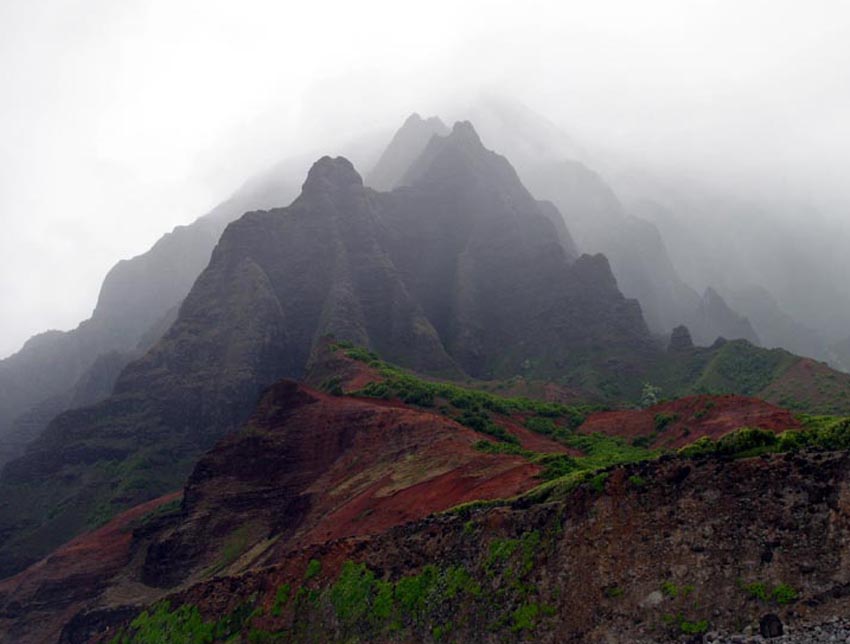
Misty Pali
(Eds. note: This is the third post of four winners in the 2006 Kauai on My Mind Creative Competition. Each will post in successive days followed by the 14 runners up, so be sure to make daily visits to kauaibackstory.com.]
by Mary Hunter Leach
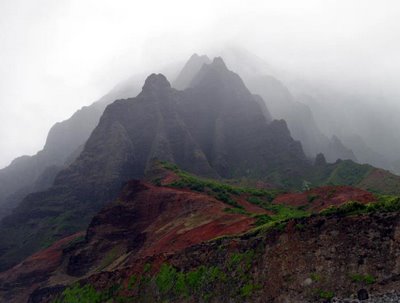
by Mary Hunter Leach
Wednesday, November 15, 2006
The Hitch-Hiker in Old Lihue Town
(Eds. note: This is the second post of four winners in the 2006 Kauai on My Mind Creative Competition. Each will post in successive days followed by the 14 runners up, so be sure to make daily visits to kauaibackstory.com.]
by Juan Lugo
She was hitch-hiking along Rice Street in old Lihue Town.
No, she appeared to be floating with her thumb and arm held high.
Long, black shiny, wind tossed hair, and midriff exposed.
Her jutting breasts were covered by a fiery red blouse.
Tight fitting jeans masquerading as skin,
...her face a study of arrogance and anger within.
Cars passed without stopping. She looked at them with an intense hateful stare.
Then, she would turn and face down the next, with a long scathing glare.
She would wipe the sweat from her face and brush back her hair.
She opened her mouth as if uttering a curse,
...I don't know if she spoke, I was too far away.
There was a haughty manner about her, demanding fear or respect.
Her shoulders were thrown back, head inclined to one side.
She had a devil-may-care attitude and obvious disdain.
She reminded me of Pele. Fire-Goddess: radiant and proud.
...cloaked in mystery from a forgotten land and a forgotten time.
She would challenge the passing cars with open contempt.
Then, she would turn around and continue her journey.
I wanted to offer her water, a soda or a place just to rest.
But, I was afraid. Afraid of her glare and afraid of her quest,
...I didn't know why and I was too scared to ask.
She marched away proudly, disgusted with those who had denied her a ride.
She knew what she wanted and didn't care what they thought.
She suddenly stopped, turned, and stared directly at me.
She smiled, winked, and filled my soul with peace.
Then she disappeared, floating, hitch-hiking,
...and walking along Rice Street in Old Lihue Town.
by Juan Lugo
She was hitch-hiking along Rice Street in old Lihue Town.
No, she appeared to be floating with her thumb and arm held high.
Long, black shiny, wind tossed hair, and midriff exposed.
Her jutting breasts were covered by a fiery red blouse.
Tight fitting jeans masquerading as skin,
...her face a study of arrogance and anger within.
Cars passed without stopping. She looked at them with an intense hateful stare.
Then, she would turn and face down the next, with a long scathing glare.
She would wipe the sweat from her face and brush back her hair.
She opened her mouth as if uttering a curse,
...I don't know if she spoke, I was too far away.
There was a haughty manner about her, demanding fear or respect.
Her shoulders were thrown back, head inclined to one side.
She had a devil-may-care attitude and obvious disdain.
She reminded me of Pele. Fire-Goddess: radiant and proud.
...cloaked in mystery from a forgotten land and a forgotten time.
She would challenge the passing cars with open contempt.
Then, she would turn around and continue her journey.
I wanted to offer her water, a soda or a place just to rest.
But, I was afraid. Afraid of her glare and afraid of her quest,
...I didn't know why and I was too scared to ask.
She marched away proudly, disgusted with those who had denied her a ride.
She knew what she wanted and didn't care what they thought.
She suddenly stopped, turned, and stared directly at me.
She smiled, winked, and filled my soul with peace.
Then she disappeared, floating, hitch-hiking,
...and walking along Rice Street in Old Lihue Town.
Tuesday, November 14, 2006
Makauwahi Cave
[Eds. note: This is the first post of four winners in the 2006 Kauai on My Mind Creative Competition. Each will post in successive days followed by the 14 runners up, so be sure to make daily visits to kauaibackstory.com.]
by Lois Ann Ell
“Where are we going again?” I asked, new to this place, new to this man, new to this life. “You’ll see,” he grinned, flashing his dark eyes at mine and then away, back to the road. The road was a dusty one, with patches of old asphalt our tires tried to link together. It soon turned to all hard red dirt, with potholes causing the rusty Ford pickup to rattle and shake, our beers foaming up inside the bottles.
We slowly drove out of familiar surroundings: passing the outskirts of the hotel golf course, passing the stables with docile trail horses tied up to fence posts, passing one abandoned cane field after another with rusted open gates. A little nervous, I otherwise felt safe with him. We finally stopped at a dead end, the dirt road suddenly swallowed up by buffalo grass. “Come on”, he whispered. We got out and started walking through the tall grass, its tiny hairs scraping my freshly shaven legs. Finally the blue ocean emerged, peeking out through the green. To the left was beach extending on with the high sun heating the sand and sparkling the sea. To the right was a large rocky cliff which the waves beat white fury into, and dark clouds hung heavily above the rocks. We headed right.
Walking along the beach with no one but ourselves to be seen, I followed him. Hopping over dead reef, trudging through a sandy stream, stepping right where he had stepped, we fell in to a rhythm—until I bumped into him, stopped still at a huge rock formation with a small opening in front of us. “Be quiet, and don’t think bad thoughts”, he said, and crawled inside the cave.
Inside was a dark dome covered in sharp, crystal stalagmites. The ground was cold and sandy and flat. “Are there bats in here?” I asked, and immediately remembered I was supposed to be quiet. He just kept going, silently slipping through another small opening to the right of the cave. This one led us into a larger cave, but revealed an open ceiling, pouring hazy sunlight in and freeing up my tight chest. A large rock was centered in the middle of the dome, with dried lei scattered upon it. I suddenly became quiet, looking around me, but I didn’t know why. We stood there for a while, silent.
Ryan told me later about Makauwahi cave at Maha’ulepu Beach, and it has since become an archeological hot spot, home now to scientists who excitedly explore it every few years. I wonder if they are quiet while they are in there.
by Lois Ann Ell
“Where are we going again?” I asked, new to this place, new to this man, new to this life. “You’ll see,” he grinned, flashing his dark eyes at mine and then away, back to the road. The road was a dusty one, with patches of old asphalt our tires tried to link together. It soon turned to all hard red dirt, with potholes causing the rusty Ford pickup to rattle and shake, our beers foaming up inside the bottles.
We slowly drove out of familiar surroundings: passing the outskirts of the hotel golf course, passing the stables with docile trail horses tied up to fence posts, passing one abandoned cane field after another with rusted open gates. A little nervous, I otherwise felt safe with him. We finally stopped at a dead end, the dirt road suddenly swallowed up by buffalo grass. “Come on”, he whispered. We got out and started walking through the tall grass, its tiny hairs scraping my freshly shaven legs. Finally the blue ocean emerged, peeking out through the green. To the left was beach extending on with the high sun heating the sand and sparkling the sea. To the right was a large rocky cliff which the waves beat white fury into, and dark clouds hung heavily above the rocks. We headed right.
Walking along the beach with no one but ourselves to be seen, I followed him. Hopping over dead reef, trudging through a sandy stream, stepping right where he had stepped, we fell in to a rhythm—until I bumped into him, stopped still at a huge rock formation with a small opening in front of us. “Be quiet, and don’t think bad thoughts”, he said, and crawled inside the cave.
Inside was a dark dome covered in sharp, crystal stalagmites. The ground was cold and sandy and flat. “Are there bats in here?” I asked, and immediately remembered I was supposed to be quiet. He just kept going, silently slipping through another small opening to the right of the cave. This one led us into a larger cave, but revealed an open ceiling, pouring hazy sunlight in and freeing up my tight chest. A large rock was centered in the middle of the dome, with dried lei scattered upon it. I suddenly became quiet, looking around me, but I didn’t know why. We stood there for a while, silent.
Ryan told me later about Makauwahi cave at Maha’ulepu Beach, and it has since become an archeological hot spot, home now to scientists who excitedly explore it every few years. I wonder if they are quiet while they are in there.
Monday, November 13, 2006
Readings at Small Town Coffee
More than 40 people filled Small Town Coffee Company on Monday, November 13 to hear winners and runners up read their entries in our 2006 Creative Competition. It was an inspiring night. Thanks to everyone who showed up and a big mahalo to the more than 60 who submitted entries in the contest. We'll do it again next year. First, though, watch for a student competition in early 2007.
Thanks, as well, to our sponsors: Small Town Coffee Company, Kauai Pasta and Blossoming Lotus.
And starting tomorrow, we'll post our winning and running up entries, one a day. So, keep checking back.
Thanks, as well, to our sponsors: Small Town Coffee Company, Kauai Pasta and Blossoming Lotus.
And starting tomorrow, we'll post our winning and running up entries, one a day. So, keep checking back.
Love Poems from a Tall Island
by Gae Rusk
I. seeking love
my land is a star
my land is lime and ocher forming
arrows
pointing to a beleaguered heart
my land has edges shaping me
glowing runway blue in my dark
I began complete
I reached land anchored
my answers sought questions but
gave up
pre-contact
so I remain alone
surveying my details
measuring my days
forming the cartography of me
someday
I will find you
studying this atlas
you are out there
on my globe somewhere
and I pray
you have learned
to read maps
gae rusk copyright 2006
I. seeking love
my land is a star
my land is lime and ocher forming
arrows
pointing to a beleaguered heart
my land has edges shaping me
glowing runway blue in my dark
I began complete
I reached land anchored
my answers sought questions but
gave up
pre-contact
so I remain alone
surveying my details
measuring my days
forming the cartography of me
someday
I will find you
studying this atlas
you are out there
on my globe somewhere
and I pray
you have learned
to read maps
gae rusk copyright 2006
Wednesday, November 08, 2006
Got Tail?
by Richard Pettigrew
Lobster tails sway side to side
Under ocean rhythms.
A heat wave current
Excites the swaying tails
To swing and shimmer a loud mating siren.
Agitated shellac bodies thrust and
Crackle towards receptive ledges.
Tails on the prowl.
Using a ray of suggestive light
The lobster undulates a full body arch
Sparking a water scent.
In the gushing of tidal flow
She holds tight the quivering tail.
Crying out.
Butter me.
Butter me, now!!!
Lobster tails sway side to side
Under ocean rhythms.
A heat wave current
Excites the swaying tails
To swing and shimmer a loud mating siren.
Agitated shellac bodies thrust and
Crackle towards receptive ledges.
Tails on the prowl.
Using a ray of suggestive light
The lobster undulates a full body arch
Sparking a water scent.
In the gushing of tidal flow
She holds tight the quivering tail.
Crying out.
Butter me.
Butter me, now!!!
Monday, October 30, 2006
A Note from Auntie Logy
[Eds. note: This is the sixth is a series by Gae Rusk under the column, "A Note from Auntie Logy." To read more from Auntie, scroll down or click on the link in the sidebar to the right.]
on
Running for Office
Auntie Logy is thinking of running for office. This current election has inspired Auntie to maybe take the plunge into politics, but when Auntie said this out loud last week at bowling league, the whole team cried out, Make sure you can swim in poop! And, Make sure you’ve had all your shots! They were saying things like that all morning, which put Auntie off her game, so Auntie went home with a bowling score like a round of golf.
But all this got Auntie thinking. If – and that’s one big IF – if Auntie Logy ran for office in one future election, what would Auntie talk about? What would Auntie support? What would Auntie Logy stand for.
So Auntie began to make one big list of positions on issues, and the first thing Auntie thought of is to raise the drinking age to 35. This alone would solve a number of public and private problems on Kauai. If you don’t believe Auntie, just ask the families of Kauai’s many alcoholics.
Then Auntie wrote down the idea of limiting helicopters and small planes to flying only offshore. That way, their noise and invasiveness would be farther away from Kauai’s residents, who have somehow become less important than the tourist-based helicopter companies. Then when those planes and helicopters fall out of the sky, which they do more and more, they would land on water and not on Auntie and her neighbors.
If nothing else, Auntie would introduce a measure encouraging all home owners to write angry messages in giant letters on their roofs, messages like “Sky Scum!” and “Tourists Go Home!” Do not scoff at Auntie Logy for suggesting this, it has worked before. Several years ago, one of Auntie’s neighbor’s cousin’s nephews painted “Fuck You” on his roof in Hanalei Valley, and guess what? Helicopters stopped whacking Hanalei Valley to death! The families living there finally regained peace and privacy, because helicopter companies did not want their passengers to see how unpopular and unwelcome they are, especially after charging tourists several hundred dollars each to take those cursed flights.
Next Auntie Logy decided the issue of requiring an EIS for the Super Ferry is not dead, even though Linda’s email this morning claimed so. Auntie says, Oh yeah? Well, if it’s such a big State supported project, then let the damn cars getting off the Ferry drive on State roads and only State roads. After circling Nawiliwili Harbor for 12 hours, they’d never bring their cars to Kauai again. Auntie believes Kauai’s families need to staunchly defend our County’s environment and infrastructure from an insidious invasive species – the State of Hawaii Department of Transportation.
Auntie knows the issue of the Super Ferry is a huge example of off-island ownership, a devastating problem for Kauai, one that would need to be front and center in Auntie’s campaign. For many, many years, Auntie has seen the movers and shakers in Honolulu pay no attention to the opinions of citizens on the outer islands. Those Oahu leaders, they all sit on the same committees and the same boards and belong to the same country clubs, which Auntie thinks is kind of creepy. Their decisions are never based on the best interests of the outer islands. Look at the shabby situation they created for patients and staff at Wilcox Hospital. Look at the decision not to build Maui a desperately needed new hospital. Look at the Super Ferry controversy.
Auntie says these Honolulu power brokers have developed an arrogant culture of outer island ownership without actually living on any of the outer islands, without really caring about the outer islands except for vacation time and big profits. Because of this Oahu-centric attitude, Auntie Logy says it’s time Kauai votes these people and possibly the State of Hawaii off this island.
What other positions could Auntie take? Oh yes, this one is important. Auntie’s dear, sweet tutu needed so much help at the end of her life, so much pain she was in. Our lovely, wonderful tutu suffered and suffered, so we all, every one of us, willingly committed the crime of buying cannabis for her. Cannabis was the only medicine that allowed her any distance from her condition. Cannabis was the only medicine that gave her a plateau of sanity. Not just Auntie Logy but the entire ohana became criminals to buy cannabis for this beloved elder to help her through the chemotherapy and the agony of her illness.
So yes, one of Auntie Logy’s positions is to get rid of the moronic law that made our ohana into a gang of criminals. Auntie is insulted by moral nazis who support such ignorant laws. Auntie would like to see the enforcers of this stupid law go to jail for life for continuing such cruelty. If elected, Auntie promises to speak out loudly against such unqualified, mean-natured incompetents running our society.
What else? Oh yes, housing for Auntie’s children, or at least access to a permit to expand Auntie’s house, which ever comes first. Possibly great-grandchildren will come before a permit, so Auntie would run for office on the platform of firing the Director of Planning and the entire Planning Department. Auntie also supports making all longtime members of the Planning Commission resign. They must be either inept or evil, because they have deliberately pointed Kauai toward illogical ruin. Auntie Logy believes any citizen who love Kauai would vote for sweeping that unqualified, possibly dirty deck clean. Auntie could probably win on this point alone.
There are so many issues to make Auntie Logy run. Auntie writes and writes letters of protest, but running for office? That will take some consideration, because Auntie has just a few little secrets that some opponent might exploit. Auntie knows this seems impossible, but remember Auntie Logy went to college in the ‘70s.
So, running is a possibility, but more on that later, because right now Auntie has to run. Mahalo nui loa for listening, you always make Auntie feel so much better. Want to go bowling sometime? Just let Auntie know. A hui hou.
Please note: Antilogy is an inconsistency or contradiction in terms or ideas,
causing controversy and discussion.
Gae Rusk copyright 2006
on
Running for Office
Auntie Logy is thinking of running for office. This current election has inspired Auntie to maybe take the plunge into politics, but when Auntie said this out loud last week at bowling league, the whole team cried out, Make sure you can swim in poop! And, Make sure you’ve had all your shots! They were saying things like that all morning, which put Auntie off her game, so Auntie went home with a bowling score like a round of golf.
But all this got Auntie thinking. If – and that’s one big IF – if Auntie Logy ran for office in one future election, what would Auntie talk about? What would Auntie support? What would Auntie Logy stand for.
So Auntie began to make one big list of positions on issues, and the first thing Auntie thought of is to raise the drinking age to 35. This alone would solve a number of public and private problems on Kauai. If you don’t believe Auntie, just ask the families of Kauai’s many alcoholics.
Then Auntie wrote down the idea of limiting helicopters and small planes to flying only offshore. That way, their noise and invasiveness would be farther away from Kauai’s residents, who have somehow become less important than the tourist-based helicopter companies. Then when those planes and helicopters fall out of the sky, which they do more and more, they would land on water and not on Auntie and her neighbors.
If nothing else, Auntie would introduce a measure encouraging all home owners to write angry messages in giant letters on their roofs, messages like “Sky Scum!” and “Tourists Go Home!” Do not scoff at Auntie Logy for suggesting this, it has worked before. Several years ago, one of Auntie’s neighbor’s cousin’s nephews painted “Fuck You” on his roof in Hanalei Valley, and guess what? Helicopters stopped whacking Hanalei Valley to death! The families living there finally regained peace and privacy, because helicopter companies did not want their passengers to see how unpopular and unwelcome they are, especially after charging tourists several hundred dollars each to take those cursed flights.
Next Auntie Logy decided the issue of requiring an EIS for the Super Ferry is not dead, even though Linda’s email this morning claimed so. Auntie says, Oh yeah? Well, if it’s such a big State supported project, then let the damn cars getting off the Ferry drive on State roads and only State roads. After circling Nawiliwili Harbor for 12 hours, they’d never bring their cars to Kauai again. Auntie believes Kauai’s families need to staunchly defend our County’s environment and infrastructure from an insidious invasive species – the State of Hawaii Department of Transportation.
Auntie knows the issue of the Super Ferry is a huge example of off-island ownership, a devastating problem for Kauai, one that would need to be front and center in Auntie’s campaign. For many, many years, Auntie has seen the movers and shakers in Honolulu pay no attention to the opinions of citizens on the outer islands. Those Oahu leaders, they all sit on the same committees and the same boards and belong to the same country clubs, which Auntie thinks is kind of creepy. Their decisions are never based on the best interests of the outer islands. Look at the shabby situation they created for patients and staff at Wilcox Hospital. Look at the decision not to build Maui a desperately needed new hospital. Look at the Super Ferry controversy.
Auntie says these Honolulu power brokers have developed an arrogant culture of outer island ownership without actually living on any of the outer islands, without really caring about the outer islands except for vacation time and big profits. Because of this Oahu-centric attitude, Auntie Logy says it’s time Kauai votes these people and possibly the State of Hawaii off this island.
What other positions could Auntie take? Oh yes, this one is important. Auntie’s dear, sweet tutu needed so much help at the end of her life, so much pain she was in. Our lovely, wonderful tutu suffered and suffered, so we all, every one of us, willingly committed the crime of buying cannabis for her. Cannabis was the only medicine that allowed her any distance from her condition. Cannabis was the only medicine that gave her a plateau of sanity. Not just Auntie Logy but the entire ohana became criminals to buy cannabis for this beloved elder to help her through the chemotherapy and the agony of her illness.
So yes, one of Auntie Logy’s positions is to get rid of the moronic law that made our ohana into a gang of criminals. Auntie is insulted by moral nazis who support such ignorant laws. Auntie would like to see the enforcers of this stupid law go to jail for life for continuing such cruelty. If elected, Auntie promises to speak out loudly against such unqualified, mean-natured incompetents running our society.
What else? Oh yes, housing for Auntie’s children, or at least access to a permit to expand Auntie’s house, which ever comes first. Possibly great-grandchildren will come before a permit, so Auntie would run for office on the platform of firing the Director of Planning and the entire Planning Department. Auntie also supports making all longtime members of the Planning Commission resign. They must be either inept or evil, because they have deliberately pointed Kauai toward illogical ruin. Auntie Logy believes any citizen who love Kauai would vote for sweeping that unqualified, possibly dirty deck clean. Auntie could probably win on this point alone.
There are so many issues to make Auntie Logy run. Auntie writes and writes letters of protest, but running for office? That will take some consideration, because Auntie has just a few little secrets that some opponent might exploit. Auntie knows this seems impossible, but remember Auntie Logy went to college in the ‘70s.
So, running is a possibility, but more on that later, because right now Auntie has to run. Mahalo nui loa for listening, you always make Auntie feel so much better. Want to go bowling sometime? Just let Auntie know. A hui hou.
Please note: Antilogy is an inconsistency or contradiction in terms or ideas,
causing controversy and discussion.
Gae Rusk copyright 2006
Monday, October 23, 2006
Kauaibackstory.com Announces Winners of 2006 Creative Competition
FOR IMMEDIATE RELEASE
Kauaibackstory.com congratulates the 2006 “Kauai on my Mind” creative competition winners Lois Ann Ell for her essay “Makawauhi Cave,” Juan Lugo for his narrative poem “The Hitch-Hiker in Old Lihue Town,” Mary Hunter Leach for her photograph “Misty Palis,” and Kimie Sadoyama for her poem “Filipinos.”
Winners and runners up (see list below) are invited to read and share their entries at Small Town Coffee Company in Kapaa on Monday, November 13, 2006 at 7:00 p.m.
Starting November 14, the submissions of the contest winners and runners up will begin posting on www.kauaibackstory.com.
Kauaibackstory.com is a venue for rigorous writing with a view about Kauai. Year-round, the on-line literary journal welcomes high-quality writing and thoughtful images from the public. All submissions are moderated by a three-person editorial board, however, not all are posted. Kauaibackstory.com encourages the expression of all voices and delights in words and images that shift thinking and open minds. Much like an on-line blog, kauaibackstory.com encourages interactive dialogue with the hopes that the time-honored tradition of kama'ilio, talk story, will build community and understanding.
Submissions must be pasted into the body of an email and sent to kauaibackstory@yahoo.com. There is no word limit—brevity is good; however, quality is better. Please acknowledge if the writing has been previously published and where/when. Visual images must be sent as jpg attachments.
Runners Up:
Richard Diamond for “The Party Dress”
Kerith Edwards for “Hems of Her Skirt”
Keahi Felix for “Mourning Bouganvillea”
Dawn Kawahara for “We Mourn Your, Raymond Napoleon”
Suzanna Kennedy for “I Surrender”
Kimberly Kirk for “Makuahine”
Mary Hunter Leach for “Wild Sea”
Charles Looney for “Walking Trail”
Coral Miles for “Returning to My Island Home”
Rocky Riedel for “The Blessing”
Carrie Rautmann for “Morning Dew” and “Homeward Bound”
Kimie Sadoyama for “Last of the Ma and Pa Stores” and “Relic of the Past Looking into the Future”
# # #
Kauaibackstory.com congratulates the 2006 “Kauai on my Mind” creative competition winners Lois Ann Ell for her essay “Makawauhi Cave,” Juan Lugo for his narrative poem “The Hitch-Hiker in Old Lihue Town,” Mary Hunter Leach for her photograph “Misty Palis,” and Kimie Sadoyama for her poem “Filipinos.”
Winners and runners up (see list below) are invited to read and share their entries at Small Town Coffee Company in Kapaa on Monday, November 13, 2006 at 7:00 p.m.
Starting November 14, the submissions of the contest winners and runners up will begin posting on www.kauaibackstory.com.
Kauaibackstory.com is a venue for rigorous writing with a view about Kauai. Year-round, the on-line literary journal welcomes high-quality writing and thoughtful images from the public. All submissions are moderated by a three-person editorial board, however, not all are posted. Kauaibackstory.com encourages the expression of all voices and delights in words and images that shift thinking and open minds. Much like an on-line blog, kauaibackstory.com encourages interactive dialogue with the hopes that the time-honored tradition of kama'ilio, talk story, will build community and understanding.
Submissions must be pasted into the body of an email and sent to kauaibackstory@yahoo.com. There is no word limit—brevity is good; however, quality is better. Please acknowledge if the writing has been previously published and where/when. Visual images must be sent as jpg attachments.
Runners Up:
Richard Diamond for “The Party Dress”
Kerith Edwards for “Hems of Her Skirt”
Keahi Felix for “Mourning Bouganvillea”
Dawn Kawahara for “We Mourn Your, Raymond Napoleon”
Suzanna Kennedy for “I Surrender”
Kimberly Kirk for “Makuahine”
Mary Hunter Leach for “Wild Sea”
Charles Looney for “Walking Trail”
Coral Miles for “Returning to My Island Home”
Rocky Riedel for “The Blessing”
Carrie Rautmann for “Morning Dew” and “Homeward Bound”
Kimie Sadoyama for “Last of the Ma and Pa Stores” and “Relic of the Past Looking into the Future”
# # #
Tuesday, October 17, 2006
Neighborhood Dogs
by Lois Ann Ell
She swaggered into the yard, swollen nipples swaying beneath her.
A broken metal chain followed silently behind her, their roles now reversed.
Her muscular brown body moved slowly in the grass.
The ones in the yard, unexpected by her presence, had mixed reactions.
The men tensed, for the breed alone made them bristle.
The baby smiled, for the dog’s panting face looked like a smile. Was it?
The yard dog hesitated, not sure whether to protect or play— and the chain trailed fast toward him.
At first smells, sniffs, slight movements.
These first few seconds
These first few moments
All yard eyes on them
Hot Kapaa sun
Everything, everyone is waiting, watching.
And then her eyes glaze, become cloudy,
Or perhaps very clear
She lunges into his neck
Locks on
As they do
Rips through fur, through flesh, through fear
One man tries to pull them apart
One man picks up the baby
And another reaches for a cement block.
She swaggered into the yard, swollen nipples swaying beneath her.
A broken metal chain followed silently behind her, their roles now reversed.
Her muscular brown body moved slowly in the grass.
The ones in the yard, unexpected by her presence, had mixed reactions.
The men tensed, for the breed alone made them bristle.
The baby smiled, for the dog’s panting face looked like a smile. Was it?
The yard dog hesitated, not sure whether to protect or play— and the chain trailed fast toward him.
At first smells, sniffs, slight movements.
These first few seconds
These first few moments
All yard eyes on them
Hot Kapaa sun
Everything, everyone is waiting, watching.
And then her eyes glaze, become cloudy,
Or perhaps very clear
She lunges into his neck
Locks on
As they do
Rips through fur, through flesh, through fear
One man tries to pull them apart
One man picks up the baby
And another reaches for a cement block.
Monday, October 09, 2006
Portrait
by Pam Woolway
She sat in front of Anahola post office with her walker
placed before her. She watched me pull into the parking
space, turn off the ignition, shift into park and step
onto the asphalt. She smiled at my dogs in the bed
of the truck. Leaning into the wall, I lingered
awhile to talk story. She told me she was waiting
for the bus. I offered her a ride home. She declined
saying that the bus driver would worry if he arrived
and she wasn't there. She mourned the loss
of her license two years ago. We talked about
freedom. Then, she looked at me with her clear,
brown eyes and said---in a tone I've used when I'm running
late for an appointment or on a Sunday night before
bed when I'm preparing for the coming week---she said: I'm already
91 years old. As if she had only just discovered it that morning.
She sat in front of Anahola post office with her walker
placed before her. She watched me pull into the parking
space, turn off the ignition, shift into park and step
onto the asphalt. She smiled at my dogs in the bed
of the truck. Leaning into the wall, I lingered
awhile to talk story. She told me she was waiting
for the bus. I offered her a ride home. She declined
saying that the bus driver would worry if he arrived
and she wasn't there. She mourned the loss
of her license two years ago. We talked about
freedom. Then, she looked at me with her clear,
brown eyes and said---in a tone I've used when I'm running
late for an appointment or on a Sunday night before
bed when I'm preparing for the coming week---she said: I'm already
91 years old. As if she had only just discovered it that morning.
Monday, October 02, 2006
For Our Children
By Kim Steutermann Rogers
A little encounter at the Maui airport: Two hours early at my gate, I jot notes in my journal as a quiet man named Henry Atay brushes crumbs, bits of paper and other debris off the carpet. He empties trash bins, polishes railings, and we talk about the brush fire raging for four days now along the west Maui mountains. He says it’s only 50% contained. He says authorities are not sure the cause—be it arson or accident. He shakes his head and says it’s not the visitors who litter our islands, it’s the locals, our kids. He says he sees young guys smoking cigarettes as they drive, holding cigarettes between thumbs and forefingers, hanging their arms out their windows and down the sides of their car doors until—cigarette singing their fingertips—they toss it aside; and he stops his cleaning to look at me with eyes soft and brown like the hint of his Polynesian nose.
Another encounter, earlier in the morning: I am leaving the hotel; it’s 6:00 a.m. and the sun is washing the same, smoldering west Maui mountains, smoke rising to greet morning mist. I ask the bell captain about the windmills dotting a nearby ridgeline. He tells me they produce 10% of the island’s electricity, yet those people up there, and he nods in the direction of gentrified Wailea, they complain, he says, the white windmills blight their views of paradise; and he turns to me, “But it’s for our children, yeah?” he says.
“Yeah,” I say, and I look up there at those houses with the views where our children don’t live, and, later, I’ll think, yeah, for our children, our cigarette-flicking children.
A little encounter at the Maui airport: Two hours early at my gate, I jot notes in my journal as a quiet man named Henry Atay brushes crumbs, bits of paper and other debris off the carpet. He empties trash bins, polishes railings, and we talk about the brush fire raging for four days now along the west Maui mountains. He says it’s only 50% contained. He says authorities are not sure the cause—be it arson or accident. He shakes his head and says it’s not the visitors who litter our islands, it’s the locals, our kids. He says he sees young guys smoking cigarettes as they drive, holding cigarettes between thumbs and forefingers, hanging their arms out their windows and down the sides of their car doors until—cigarette singing their fingertips—they toss it aside; and he stops his cleaning to look at me with eyes soft and brown like the hint of his Polynesian nose.
Another encounter, earlier in the morning: I am leaving the hotel; it’s 6:00 a.m. and the sun is washing the same, smoldering west Maui mountains, smoke rising to greet morning mist. I ask the bell captain about the windmills dotting a nearby ridgeline. He tells me they produce 10% of the island’s electricity, yet those people up there, and he nods in the direction of gentrified Wailea, they complain, he says, the white windmills blight their views of paradise; and he turns to me, “But it’s for our children, yeah?” he says.
“Yeah,” I say, and I look up there at those houses with the views where our children don’t live, and, later, I’ll think, yeah, for our children, our cigarette-flicking children.
Thursday, September 28, 2006
A Note from Auntie Logy
[Eds. note: This is the fifth is a series by Gae Rusk under the column, "A Note from Auntie Logy." To read more from Auntie, scroll down or click on the link in the sidebar to the right.]
on SHAME
Auntie Logy returned from the mainland yesterday. It was a stressful trip back to Kauai, but Auntie recovered happiness after arriving at the family’s orchard outside Kilauea, and Auntie stayed happy to be home until picking up a copy of The Garden Island. That’s when Auntie Logy had one big hissy fit.
When Auntie could breathe again, she asked herself, Is Kauai now third world? Is Kauai now Haiti-West? Are cronyism and palsy-walsyism now a given? Auntie is thinking maybe Senator Barak Obama should come to Kauai to present the same anti-corruption speech he gave in Kenya.
Auntie is ashamed of all the self-centered special interests who want to run this island. For the last four decades, Auntie has been ashamed of County officials who awarded heinous building permits, sometimes secretly and illegally. Auntie has felt shamed by power struggles that make no sense to anyone watching.
There are other shames alive and well on this island, it’s true, like that judge, the one who dismissed charges against Kauai’s most well-connected career criminal in the face of all evidence of guilt? Maybe that judge lives on Oahu? If so, it’s of no matter to her who roams free to trash this island.
And Kauai’s youths, those angry boys who flap around in clothing ten sizes too big for their bodies? Auntie sees them dressing their egos, not their waistlines. And the way they talk, are they as dumb as Auntie’s tree line? Has Kauai dumbed-down to accommodate the slow and dysfunctional, so the whole island is becoming slow and dysfunctional? This is a scary thought that Auntie has tried to avoid for a long time, but articles in The Garden Island always put it front page center.
Auntie Logy is ashamed of being ashamed of so much about this new Kauai. Auntie is afraid she sounds old-fashioned and whiney, but Kauai is Auntie’s home! Auntie’s ohana, Auntie’s calabash family, all live on Kauai, and now it is difficult for any of us to thrive here. It is stressful to give aloha to malahines who steal our beaches at night and put in gated communities without asking. It is impossible to think kindly of absentee landlords who turned Hanalei and Kapaa and Waipouli and Wailua into time-shared, strip-malled hells. It is hopeless to have any respect for officials giving out permits to pave over Kauai.
Stir these crimes against Kauai’s communities into the brew of Kauai’s future grownups, those clothes-flopping, moronic-sounding youths with cars and money and no self-discipline, claiming freedom without training or responsibility. Stir all this together and what do you have? Something worse than Maui. Something like Haiti, a toxic, urbanized atoll in a shallow, torpid ocean.
It is exhausting for Auntie to keep making protests that are no doubt ignored and discounted. It takes a lot more effort to live here than ever before, and this is wearing Auntie raw, and Auntie is not alone. One neighbor said to Auntie, There is so much to protest! Suddenly everything’s going bad at once!
Auntie’s neighbor, he’s right. He’s smart too, so he protests when he can, just like Auntie, and everyone’s tired already. Who let things get so bad so fast? Kauai is going crazy, ho’o pupule, just like Maui. Going garbage, ho’o pilau, just like Haiti.
Which brings up a question Auntie has asked before: Where is Kauai’s Chief? Please, Kaumuali’i, come home soon! We have our backs to the sea cliffs now, dear Chief, and we need you.
Oops, Auntie has to run! One blasted red helicopter is chopping overhead. Auntie has to go outside and curse it forever and calm the dogs. But Auntie does feel better for talking to you. Mahalo nui loa for listening. A hui hou.
Please note, antilogy is an inconsistency or controversy in terms or ideas, causing controversy and discussion.
Gae Rusk copyright 2006
on SHAME
Auntie Logy returned from the mainland yesterday. It was a stressful trip back to Kauai, but Auntie recovered happiness after arriving at the family’s orchard outside Kilauea, and Auntie stayed happy to be home until picking up a copy of The Garden Island. That’s when Auntie Logy had one big hissy fit.
When Auntie could breathe again, she asked herself, Is Kauai now third world? Is Kauai now Haiti-West? Are cronyism and palsy-walsyism now a given? Auntie is thinking maybe Senator Barak Obama should come to Kauai to present the same anti-corruption speech he gave in Kenya.
Auntie is ashamed of all the self-centered special interests who want to run this island. For the last four decades, Auntie has been ashamed of County officials who awarded heinous building permits, sometimes secretly and illegally. Auntie has felt shamed by power struggles that make no sense to anyone watching.
There are other shames alive and well on this island, it’s true, like that judge, the one who dismissed charges against Kauai’s most well-connected career criminal in the face of all evidence of guilt? Maybe that judge lives on Oahu? If so, it’s of no matter to her who roams free to trash this island.
And Kauai’s youths, those angry boys who flap around in clothing ten sizes too big for their bodies? Auntie sees them dressing their egos, not their waistlines. And the way they talk, are they as dumb as Auntie’s tree line? Has Kauai dumbed-down to accommodate the slow and dysfunctional, so the whole island is becoming slow and dysfunctional? This is a scary thought that Auntie has tried to avoid for a long time, but articles in The Garden Island always put it front page center.
Auntie Logy is ashamed of being ashamed of so much about this new Kauai. Auntie is afraid she sounds old-fashioned and whiney, but Kauai is Auntie’s home! Auntie’s ohana, Auntie’s calabash family, all live on Kauai, and now it is difficult for any of us to thrive here. It is stressful to give aloha to malahines who steal our beaches at night and put in gated communities without asking. It is impossible to think kindly of absentee landlords who turned Hanalei and Kapaa and Waipouli and Wailua into time-shared, strip-malled hells. It is hopeless to have any respect for officials giving out permits to pave over Kauai.
Stir these crimes against Kauai’s communities into the brew of Kauai’s future grownups, those clothes-flopping, moronic-sounding youths with cars and money and no self-discipline, claiming freedom without training or responsibility. Stir all this together and what do you have? Something worse than Maui. Something like Haiti, a toxic, urbanized atoll in a shallow, torpid ocean.
It is exhausting for Auntie to keep making protests that are no doubt ignored and discounted. It takes a lot more effort to live here than ever before, and this is wearing Auntie raw, and Auntie is not alone. One neighbor said to Auntie, There is so much to protest! Suddenly everything’s going bad at once!
Auntie’s neighbor, he’s right. He’s smart too, so he protests when he can, just like Auntie, and everyone’s tired already. Who let things get so bad so fast? Kauai is going crazy, ho’o pupule, just like Maui. Going garbage, ho’o pilau, just like Haiti.
Which brings up a question Auntie has asked before: Where is Kauai’s Chief? Please, Kaumuali’i, come home soon! We have our backs to the sea cliffs now, dear Chief, and we need you.
Oops, Auntie has to run! One blasted red helicopter is chopping overhead. Auntie has to go outside and curse it forever and calm the dogs. But Auntie does feel better for talking to you. Mahalo nui loa for listening. A hui hou.
Please note, antilogy is an inconsistency or controversy in terms or ideas, causing controversy and discussion.
Gae Rusk copyright 2006
Monday, September 11, 2006
Feared Drunk
[Author's note: This poem was entered in a contest while attending KCC at the request of my "Literature and Medicine" instructor. It won first place in Hawaii and went on to the national literary competition where it took second place.]
by Pam Woolway
Feared Drunk
Suddenly nobody knows where you are,
your body thin as mother’s milk,
your mind tipping like a teacup
on the flesh of a split lip.
Your body is never left alone,
a daughter or your husband sit
like sparrows sipping from an
abandoned spring.
You see things only you alone
can see; Yogi the Bear, The
Virgin Mary and a family
of literate mice.
Lucid dreams leave
your family waiting outside
the picture frame:
You paint Mary leaning
against a pine tree,
Yogi is drinking coffee on
a street corner and
the mouse delivers a note.
Then, from the bed, your gaze turns
from a pearl into a bullet.
You know exactly where you are.
Coming closer, you see the family
resembles a hungry pack
of winter worn wolves.
But there’s no den to retreat into
and no drugs to soften the return.
Once you survive
an addiction,
it becomes the duck
that ate the bread
that does not lead back home,
but rather
to a hot and yawning oven.
by Pam Woolway
Feared Drunk
Suddenly nobody knows where you are,
your body thin as mother’s milk,
your mind tipping like a teacup
on the flesh of a split lip.
Your body is never left alone,
a daughter or your husband sit
like sparrows sipping from an
abandoned spring.
You see things only you alone
can see; Yogi the Bear, The
Virgin Mary and a family
of literate mice.
Lucid dreams leave
your family waiting outside
the picture frame:
You paint Mary leaning
against a pine tree,
Yogi is drinking coffee on
a street corner and
the mouse delivers a note.
Then, from the bed, your gaze turns
from a pearl into a bullet.
You know exactly where you are.
Coming closer, you see the family
resembles a hungry pack
of winter worn wolves.
But there’s no den to retreat into
and no drugs to soften the return.
Once you survive
an addiction,
it becomes the duck
that ate the bread
that does not lead back home,
but rather
to a hot and yawning oven.
Wednesday, September 06, 2006
Ark of Mu
by Craig Davies
From out of the Blue…such Beauty to see.
The Earth at Peace was unveiled to me.
The Future I trust; One World...we are Free.
I asked of the Blue how this came to be.
I saw turbulent seas; black was the sky.
The end had come with no tear in my eye.
In the midst of the chaos, a vessel so small,
Tossing and turning yet, surviving it all.
Transcending all conflict; with darkness withdrawn,
The Good Ship Kauai ushers in a New Dawn.
All becomes Peaceful; my vision is true.
A New Beginning...We're the Ark of MU.
From out of the Blue…such Beauty to see.
The Earth at Peace was unveiled to me.
The Future I trust; One World...we are Free.
I asked of the Blue how this came to be.
I saw turbulent seas; black was the sky.
The end had come with no tear in my eye.
In the midst of the chaos, a vessel so small,
Tossing and turning yet, surviving it all.
Transcending all conflict; with darkness withdrawn,
The Good Ship Kauai ushers in a New Dawn.
All becomes Peaceful; my vision is true.
A New Beginning...We're the Ark of MU.
Thursday, August 31, 2006
A Note from Auntie Logy
On Kauai Needs a Chief
by Gae Rusk
(Eds. note: This is the fourth is a series by Gae Rusk under the column, "A Note from Auntie Logy.)
It’s almost election time again. Auntie Logy has written down both voting dates, September and November, and highlighted them in green.
It’s hard, that’s what Auntie thinks, voting for Kauai’s future. Auntie watches smart and kind candidates fight a constant battle to save Kauai from greedy and stupid ones, who somehow get elected too.
After studying this year’s roster, Auntie arrived at one obvious, long overdue conclusion: Forget another Mayor, forget more Council people, what Kauai desperately needs is one pig-headed, clear-hearted Chief.
Man or woman is not important. Race is less important, and shame on anyone who thinks otherwise. What we truly need is one extra strong individual who loves Kauai, even if he or she is orange or blue, that’s what Auntie says. Someone with strong character who can steer Kauai through this hostile ocean filled with putrid waste, social catastrophe and floating political turds. We need a Chief who can face all these ills without flinching, then fix them one by one.
Auntie’s thoughts on what this Chief could do? For one, Kauai needs a leader who will return to our schools and get rid of the National testing and the State testing and all the career test givers, and instead teach those angry boys and mean girls they are responsible for the future. Invest them with reasons to care and goals to reach, and do it soon.
Auntie needs a Chief who will stop invasive air traffic and push it all off shore, and a Chief who will punish the noisy, heavy trucks destroying our one small Hwy. All this machinery everywhere, on and above Kauai! This seems completely lolo to Auntie Logy.
We need a Chief who will not allow one more person to pave over one more inch of Kauai. This includes stopping proposed changes up at Kokee, and Auntie says shame on all of you involved in promoting parking lots and hotels at the crown of Kauai.
Obviously, our leaders have not been strong enough to say no to those making Kauai a tropical monopoly board. That makes Auntie certain Kauai needs a Chief who will take this island away from those who don’t live here. Auntie Logy is not just thinking Kokee, Auntie is also thinking Wilcox Hospital. Auntie is thinking vacation rentals consuming Hanalei. Auntie is thinking of real estate gamers who have operated here with impunity for the last 10 years and 2 regimes.
What is vital is finding a Chief who will not delegate away authority as reward for political support. This time-honored policy has brought Kauai to its knees. Since the last election, Auntie’s knees have grown too sore to kneel before any more incompetents.
Most important? Kauai needs a Chief who considers self righteous entitlement an infectious mental disorder. Kauai needs a Chief who will not back down in the face of this mania, no matter how scary, because self-centered, self-serving behavior has crippled Kauai.
That’s a good start, yeah? This Chief could be among us, yeah? Auntie Logy certainly hopes so. Auntie prays this Chief will rise with honor and act with dignity and strive to make Kauai more intelligent and valuable.
Auntie also prays this Chief will surface soon. Otherwise, Auntie Logy will be moving somewhere like New Zealand or Canada, where logic appears to have a larger role in daily life.
Please note: Antilogy is an inconsistency or contradiction in terms or ideas,
causing controversy and discussion.
Gae Rusk copyright 2006
by Gae Rusk
(Eds. note: This is the fourth is a series by Gae Rusk under the column, "A Note from Auntie Logy.)
It’s almost election time again. Auntie Logy has written down both voting dates, September and November, and highlighted them in green.
It’s hard, that’s what Auntie thinks, voting for Kauai’s future. Auntie watches smart and kind candidates fight a constant battle to save Kauai from greedy and stupid ones, who somehow get elected too.
After studying this year’s roster, Auntie arrived at one obvious, long overdue conclusion: Forget another Mayor, forget more Council people, what Kauai desperately needs is one pig-headed, clear-hearted Chief.
Man or woman is not important. Race is less important, and shame on anyone who thinks otherwise. What we truly need is one extra strong individual who loves Kauai, even if he or she is orange or blue, that’s what Auntie says. Someone with strong character who can steer Kauai through this hostile ocean filled with putrid waste, social catastrophe and floating political turds. We need a Chief who can face all these ills without flinching, then fix them one by one.
Auntie’s thoughts on what this Chief could do? For one, Kauai needs a leader who will return to our schools and get rid of the National testing and the State testing and all the career test givers, and instead teach those angry boys and mean girls they are responsible for the future. Invest them with reasons to care and goals to reach, and do it soon.
Auntie needs a Chief who will stop invasive air traffic and push it all off shore, and a Chief who will punish the noisy, heavy trucks destroying our one small Hwy. All this machinery everywhere, on and above Kauai! This seems completely lolo to Auntie Logy.
We need a Chief who will not allow one more person to pave over one more inch of Kauai. This includes stopping proposed changes up at Kokee, and Auntie says shame on all of you involved in promoting parking lots and hotels at the crown of Kauai.
Obviously, our leaders have not been strong enough to say no to those making Kauai a tropical monopoly board. That makes Auntie certain Kauai needs a Chief who will take this island away from those who don’t live here. Auntie Logy is not just thinking Kokee, Auntie is also thinking Wilcox Hospital. Auntie is thinking vacation rentals consuming Hanalei. Auntie is thinking of real estate gamers who have operated here with impunity for the last 10 years and 2 regimes.
What is vital is finding a Chief who will not delegate away authority as reward for political support. This time-honored policy has brought Kauai to its knees. Since the last election, Auntie’s knees have grown too sore to kneel before any more incompetents.
Most important? Kauai needs a Chief who considers self righteous entitlement an infectious mental disorder. Kauai needs a Chief who will not back down in the face of this mania, no matter how scary, because self-centered, self-serving behavior has crippled Kauai.
That’s a good start, yeah? This Chief could be among us, yeah? Auntie Logy certainly hopes so. Auntie prays this Chief will rise with honor and act with dignity and strive to make Kauai more intelligent and valuable.
Auntie also prays this Chief will surface soon. Otherwise, Auntie Logy will be moving somewhere like New Zealand or Canada, where logic appears to have a larger role in daily life.
There now, Auntie Logy spoke her mind. Auntie feels much better. A hui hou.
Please note: Antilogy is an inconsistency or contradiction in terms or ideas,
causing controversy and discussion.
Gae Rusk copyright 2006
Monday, August 28, 2006
Waipouli
(Editors' note: This was written while the author was waiting to testify at the Aug. 22 planning commission meeting public hearing on two proposed timeshare resorts at Waipouli.)
By Mehana Blaich Vaughan
Lu’au in Waipouli
For Hi’iaka
Returned from Hawai’i safe
But without Lohi’au.
For Hi’iaka
The i’a laden on la’i has no taste,
The beat of the ipu
holds no call to hula
The flickering torches
Give slim light.
Amidst the festivities
Hi’iaka mourns
And begins to oli
A chant she wrote with Lohi’au
On their journey.
And a voice joins hers
Chanting the same words.
Startled, she switches oli,
This one they wrote
At the edge of the volcano
Pele’s lava coming fast,
Again the voice chants the words
With her, together.
Lohi’au.
Kaua’i o Kamawaelualani e
In high school,
My class got to help
With an archaeology dig
Here in this grove.
Soft clatter of coconut leaves,
Wind filtered through ironwoods,
Dunes ma kai
Far off profile of Nonou, ma uka.
I sifted bucket after bucket of one
Grit in my eyes
Blistered hands
Smiling in wonder
That a fishing village
Once stood
Here
That it left
So little
Trace
Save the ‘opihi shells, charcoal bits,
And one bone fish hook
I wondered to hold
In my hand.
Kaua’i o Manokalanipo
Excavator metal teeth
Hit bone
Grating it
Into dust
Too
Small
To sort through
An archaeologist’s screen
To wrap in fresh kapa,
Softened lauhala.
Just shovel it over there on that pile
The one surrounded by fence
Where the workers tell each other not to go
Even if something you need
Blows
In.
I wonder whose kupuna
she
Was.
Kaua’i, the Garden Isle
Aloha Airlines
First flight
Honolulu to Lihu’e
Full
With construction workers.
Matching t-shirts, jeans, and boots
Ali’i Diamond Club Members all
Commuting everyday.
The uncle next to me says
Most of them are working with him
Building
Waipouli Beach Resort.
Kaua’i, Healthy Economy
Coral concrete
Turquoise windows
For seeing out, not in
Fake waterfalls
And a “cultural preserve”
Where they moved the bones.
You too, can own
A piece of paradise.
Kaua’i, A Separate Kingdom
Ocean breeze blocked
Hot rising from the highway
Edged by dusty trash
Engines idle
Heat and Exhaust
On a clump of tourists
Desperately seeking
A way to cross the sea
Of cars
for food.
Kaua’i, Garden of Eden
A young mother sits in a rusty pickup waiting for the light to turn.
Dashed for groceries on her way home from one job to change for another.
She’s adding the bill again in her head
Confirming that less food, cost more money, than last month.
Rent still not paid.
The light doesn’t change.
Her oldest will have to cook.
She hopes she’ll have time to hug them each
To ask about school
Even if she can’t hear the answer.
She hopes the groceries in the back
of the pick up will
Last.
Kaua’i, Home
Me one day with babies,
Kids I hope will love Kaua’i
As we were raised to
Telling them Waipouli once had
Clear dark fresh waters
Flowing clean to the sea
And places you could see
The mountains
And the ocean
Even both at the same time.
I hope they can
touch ground that might
still hold a fish hook.
We will oli
And remember Hi’iaka.
Kaua’i, Hemolele i ka Malie
By Mehana Blaich Vaughan
Lu’au in Waipouli
For Hi’iaka
Returned from Hawai’i safe
But without Lohi’au.
For Hi’iaka
The i’a laden on la’i has no taste,
The beat of the ipu
holds no call to hula
The flickering torches
Give slim light.
Amidst the festivities
Hi’iaka mourns
And begins to oli
A chant she wrote with Lohi’au
On their journey.
And a voice joins hers
Chanting the same words.
Startled, she switches oli,
This one they wrote
At the edge of the volcano
Pele’s lava coming fast,
Again the voice chants the words
With her, together.
Lohi’au.
Kaua’i o Kamawaelualani e
In high school,
My class got to help
With an archaeology dig
Here in this grove.
Soft clatter of coconut leaves,
Wind filtered through ironwoods,
Dunes ma kai
Far off profile of Nonou, ma uka.
I sifted bucket after bucket of one
Grit in my eyes
Blistered hands
Smiling in wonder
That a fishing village
Once stood
Here
That it left
So little
Trace
Save the ‘opihi shells, charcoal bits,
And one bone fish hook
I wondered to hold
In my hand.
Kaua’i o Manokalanipo
Excavator metal teeth
Hit bone
Grating it
Into dust
Too
Small
To sort through
An archaeologist’s screen
To wrap in fresh kapa,
Softened lauhala.
Just shovel it over there on that pile
The one surrounded by fence
Where the workers tell each other not to go
Even if something you need
Blows
In.
I wonder whose kupuna
she
Was.
Kaua’i, the Garden Isle
Aloha Airlines
First flight
Honolulu to Lihu’e
Full
With construction workers.
Matching t-shirts, jeans, and boots
Ali’i Diamond Club Members all
Commuting everyday.
The uncle next to me says
Most of them are working with him
Building
Waipouli Beach Resort.
Kaua’i, Healthy Economy
Coral concrete
Turquoise windows
For seeing out, not in
Fake waterfalls
And a “cultural preserve”
Where they moved the bones.
You too, can own
A piece of paradise.
Kaua’i, A Separate Kingdom
Ocean breeze blocked
Hot rising from the highway
Edged by dusty trash
Engines idle
Heat and Exhaust
On a clump of tourists
Desperately seeking
A way to cross the sea
Of cars
for food.
Kaua’i, Garden of Eden
A young mother sits in a rusty pickup waiting for the light to turn.
Dashed for groceries on her way home from one job to change for another.
She’s adding the bill again in her head
Confirming that less food, cost more money, than last month.
Rent still not paid.
The light doesn’t change.
Her oldest will have to cook.
She hopes she’ll have time to hug them each
To ask about school
Even if she can’t hear the answer.
She hopes the groceries in the back
of the pick up will
Last.
Kaua’i, Home
Me one day with babies,
Kids I hope will love Kaua’i
As we were raised to
Telling them Waipouli once had
Clear dark fresh waters
Flowing clean to the sea
And places you could see
The mountains
And the ocean
Even both at the same time.
I hope they can
touch ground that might
still hold a fish hook.
We will oli
And remember Hi’iaka.
Kaua’i, Hemolele i ka Malie
Sunday, August 20, 2006
Foiled
By Pam Woolway
Hunger drives her to explore all the dark places;
empty crumb-filled corners
A hollow belly eclipses risk;
she nudges her whiskered head through the tattered hole
Weary waitress at midnight races toward home;
driving fifty in a thirty-five
Nocturnal, curious, feral and unrefined,
two girls working nights
Feline silhouette wavers drunkenly,
blindly staggering toward the street
Tires swerve to the shoulder;
slipping on wet grass
The waitress abandons her car and
tenderly stalks the small hooded creature
Her prey senses a predator;
furred muscles contract into a crouch preparing to spring
An arm’s length away,
pluck the metalic chip bag from the cat’s head.
Hunger drives her to explore all the dark places;
empty crumb-filled corners
A hollow belly eclipses risk;
she nudges her whiskered head through the tattered hole
Weary waitress at midnight races toward home;
driving fifty in a thirty-five
Nocturnal, curious, feral and unrefined,
two girls working nights
Feline silhouette wavers drunkenly,
blindly staggering toward the street
Tires swerve to the shoulder;
slipping on wet grass
The waitress abandons her car and
tenderly stalks the small hooded creature
Her prey senses a predator;
furred muscles contract into a crouch preparing to spring
An arm’s length away,
pluck the metalic chip bag from the cat’s head.
Wednesday, August 16, 2006
Rooster Peace
by Kim Steutermann Rogers
I’ve made peace with the chickens. Not that there’s peace, mind you. They still crow at 3:00 a.m., because my neighbor on the hill constantly forgets to turn off their outdoor lights which beam spotlights into our bedroom window. I crow about that to my husband. How is it those beacons in the night, I ask, don’t shine in their bedroom window, too? But this isn’t about my neighbors; it’s about the chickens.
Chickens roam free on Kauai. The moa, as named in Hawaiian, arrived with the first Polynesians and, so, are some of our island’s first residents and protected, at that. I’m told the fine for harming one on state land is $500. Centuries later, when the Filipinos arrived, they brought their cultural practice of cockfighting (although illegal here) across the sea to Hawaii—a decided insurance policy to the island’s chicken population. (Those pup-tent-looking structures you see lined up in various communities around the island house roosters bred for fighting.)
On Rice Street in downtown Lihue—not to mention every other road around the island, paved or not, one lane or two—it’s not unusual to see traffic stopped waiting for a hen and her line of chicks to cross the road. Not all make it, of course, especially on the highway. We have very little animal life on Kauai—no squirrels, no rabbits, no mongoose—and so on those occasions when the chicken does not reach the other side of the road, they become not just road kill but the road itself. You see, while the county sends out its animal control paddy wagon to pick up the occasional cat or dog that meets the same fate, I’ve yet to see a dead chicken scraped off the road. They’re left until they’re so flattened that they're imbedded in the pavement; you'd need a backhoe to pry them up.
At our previous home—the rental overlooking Aliomanu Bay—we sat perched 60 feet above the water. For some reason, the chickens rarely ventured up our steep drive. But the first night we moved into our new, half-built house, however, one chicken roamed right up to our bedroom window—the same one in which our neighbor’s lights shine—and crowed. It was 3:00 a.m. Since then, I’ve learned not all roosters crow alike, and I think it’s related to age. That, or just different personalities, like you and I have different laughs, say. But before I came to this knowledge, before I made my peace with chickens, before the first cockle stopped bolting me upright at 3:00 a.m., I wasn’t so unruffled about the chickens. And neither was Eric. He would rise, sneak outside—picking up a few rocks leftover from the foundation’s base—and lob them at the rooster. (Well, I don’t know if lob is the right word, but I don’t think he ever mortally wounded one.)
They say Kauai has more chickens than any other island, because of one incident at Nawiliwili Harbor maybe a hundred years ago when a crate of mongoose were sent to all the islands. A dockhand, so the story goes, tossed Kauai's crate of the critters into the water after one of the rodents bit him. And now we are the only Hawaiian island without a mongoose population problem.
In the new house, it wasn’t long before my alarm of roosters shifted to ticks. It seems we’d moved to the center of tickdom. The actual breeding grounds of the bloodsuckers. The Mecca of all ticks. My little Penny became infested. They’d latch on the poor girl, suck her dry and when the "fattie" was so bloated with Penny’s blood that it couldn’t hold on anymore, it would fall off and roll into the cranny where the hardwood floors stopped and the sheet-rocked walls started--a veritable protected, womb for hundreds of tick eggs to hatch. And it usually happened at night. Because our bed was then on the floor—no hand-carved teak bed from Indonesia yet—the hatched babies also crawled up our mattress, under our covers and latched onto me, too. I'd wake several times a night and pick the creepy crawlies off my body. It seems about this time I stopped noticing the crowing and bumped up "installing baseboard" to the top of the to-do list.
With virtually no predators—except rats which, for some reason, don’t eat all the eggs—chickens reproduce faster than rabbits, and so they’re everywhere. Pecking along the fringes of the beaches, cleaning up at the outdoor eatery down the street called Ono Charburger, even at the top of the mountain in Kokee State Park. Another story shares that Hurricane Iniki freed the fighting roosters in 1992 and spread them to all corners of the island, leading to an island-wide spread of chickens and roosters in the most unusual places. Tourists love them—so much so I’ll bet more pictures of chickens depart the island than those of endangered Humpback whales in winter.
Months later—after lifting the bed onto a frame and picking hundreds of ticks off Penny at a time—we got the tick problem under control while chickens paraded across our yard with chicks in tow. I learned how territorial roosters are. How they are not monogamous; they have a harem, in fact. How they crow all day long, at any hour, not just dawn.
But I still hadn’t made my peace with them. Not quite. It wasn’t until a friend told me about her laying hens. How she let them out of the coop to roam in her yard during the day. How they ate the bugs in her yard. The mosquitoes, the beetles, the roaches, the centipedes. And, in a moment of insight, I blurted, “The ticks. The chickens eat the ticks.”
And that’s when I made peace with the chickens. They rose another rung on my ladder of respect when watering my soon-to-be magnificent hedge of native white hibiscus I discovered holes in its leaves. Almost every other leaf had been nibbled through like ornate, Italian lace. I plucked a leaf off one of my sweet-smelling prizes and took it to Marit at Growing Greens Nursery. “Night beetle,” she said and suggested I place solar lights around the plants to drive off the beetles which only feed at night. With the light, she said, they’d mosey on—to another unsuspecting plant, no doubt—and leave my beauties beetle-free. Of course, I was also counting on my newly-discovered secret weapon to gobble up those beetles in their tracks.
After a year of hearing roosters crow in the night, I’ve grown used to them. Still, every now and then, one plants himself below our bedroom window, blasts a cockle-doodle-do, and I wake up, but I don’t mind so much anymore. Not as long as they eat a few ticks and night beetles at the same time.
# # #
Sunday, August 06, 2006
PARADISANOIA
by Gae Rusk
copyright 2005
I will attempt to be
less bewildered by hate
less surprised by insult
less appalled by malice and
undestroyed by lies
however
there are snakes in this paradise
and they can walk
and talk and
stand on my land
and gloat at my home
What can I do?
What can I do to
stop them?
Where can I go
that they are not there
and there and
there!
But this paradise
of walking snakes
is an island
and I go round and round
for family’s sake
I go to high ground
and sit here
and wait
copyright 2005
I will attempt to be
less bewildered by hate
less surprised by insult
less appalled by malice and
undestroyed by lies
however
there are snakes in this paradise
and they can walk
and talk and
stand on my land
and gloat at my home
What can I do?
What can I do to
stop them?
Where can I go
that they are not there
and there and
there!
But this paradise
of walking snakes
is an island
and I go round and round
for family’s sake
I go to high ground
and sit here
and wait
Sunday, July 23, 2006
A Note from Auntie Logy
[Editor's note: This is the third in a series by Gae Rusk.]
On Helicopters
by Gae Rusk
Today, seven helicopters went over Auntie Logy’s house. Each time it happened, Auntie panicked. Each time, Auntie ran down the steps and out onto the grass and hovered anxiously between farmhouse and orchard, tortured by the rotors’ whacking roar. Seven times today, Auntie’s heartbeat was sabotaged.
It is possible Auntie’s extreme reaction is due to being a citizen-veteran of two small wars. Being a citizen-veteran means Auntie has an exaggerated startle response. As a citizen-vet, Auntie fears the helicopters will fall from the sky.
This fear is real, helicopters do fall from the sky all the time. Auntie personally knows dead pilots and dead passengers from more than one helicopter crash, so it would be better if they all stayed offshore. If helicopters stayed above open water instead of above us, when they crash, which they will, at least they will land on water and not on Auntie, but helicopters give hostile excuses about needing to be over land for safety reasons.
I ask you, whose safety do they mean? Not the safety of people cowering below, that’s for sure. Not the safety of Auntie. Helicopters believe they are more important than Auntie, who lives and works at ground level. Helicopters have gotten away with this bizarre thinking, backwards thinking, opposite to logic thinking, to the point that no one knows how to stop them from chopping across the sky over our homes.
This enrages Auntie. Yes, helicopters flying over her quiet neighborhood incite rage in Auntie Logy, and not just for safety reasons. Some helicopters come over way too low, even though a minimum altitude rule exists, and Auntie’s neighbor has landed one in his front yard more than once. He did not care that Auntie had panic attacks when his machine spiralled down over her roof. None of those helicopters care that Auntie rushes outside and runs in circles with the desperate dogs, the horses next door fleeing from end to end of their pasture, eyes rolling wildly and all of us risking broken legs.
Auntie screams, “Sky scum!” at the helicopters. Hoarse from the effort, Auntie yells, “Bastards!” and Auntie vows yet again to paint this across the roof of the barn. Then, crippled by the rigor of her startle response to yet another murdering of peace and air, Auntie Logy limps inside and runs cold well water over her wrists.
Obviously, Auntie cannot stop those helicopters from going anywhere they want. They’ve had their way so long, since 1962, they claim a common law marriage with Kauai’s air space.
And Auntie cannot change the fact that living in war zones has shaped her response to helicopters. Auntie will never heal if they continue their wilful ways, violating and damaging Auntie from above. Seven times today, so far.
Is Auntie Logy the only one thinking this? Are there other citizen-vets disabled and destroyed by helicopters in our sky? Is there a County Council member who agrees with Auntie that helicopters should stay offshore? If so, may the island’s God of Peace and Quiet bless you forever.
Please note: Antilogy is an inconsistency or contradiction in terms or ideas,
causing controversy and discussion.
Gae Rusk copyright 2006
On Helicopters
by Gae Rusk
Today, seven helicopters went over Auntie Logy’s house. Each time it happened, Auntie panicked. Each time, Auntie ran down the steps and out onto the grass and hovered anxiously between farmhouse and orchard, tortured by the rotors’ whacking roar. Seven times today, Auntie’s heartbeat was sabotaged.
It is possible Auntie’s extreme reaction is due to being a citizen-veteran of two small wars. Being a citizen-veteran means Auntie has an exaggerated startle response. As a citizen-vet, Auntie fears the helicopters will fall from the sky.
This fear is real, helicopters do fall from the sky all the time. Auntie personally knows dead pilots and dead passengers from more than one helicopter crash, so it would be better if they all stayed offshore. If helicopters stayed above open water instead of above us, when they crash, which they will, at least they will land on water and not on Auntie, but helicopters give hostile excuses about needing to be over land for safety reasons.
I ask you, whose safety do they mean? Not the safety of people cowering below, that’s for sure. Not the safety of Auntie. Helicopters believe they are more important than Auntie, who lives and works at ground level. Helicopters have gotten away with this bizarre thinking, backwards thinking, opposite to logic thinking, to the point that no one knows how to stop them from chopping across the sky over our homes.
This enrages Auntie. Yes, helicopters flying over her quiet neighborhood incite rage in Auntie Logy, and not just for safety reasons. Some helicopters come over way too low, even though a minimum altitude rule exists, and Auntie’s neighbor has landed one in his front yard more than once. He did not care that Auntie had panic attacks when his machine spiralled down over her roof. None of those helicopters care that Auntie rushes outside and runs in circles with the desperate dogs, the horses next door fleeing from end to end of their pasture, eyes rolling wildly and all of us risking broken legs.
Auntie screams, “Sky scum!” at the helicopters. Hoarse from the effort, Auntie yells, “Bastards!” and Auntie vows yet again to paint this across the roof of the barn. Then, crippled by the rigor of her startle response to yet another murdering of peace and air, Auntie Logy limps inside and runs cold well water over her wrists.
Obviously, Auntie cannot stop those helicopters from going anywhere they want. They’ve had their way so long, since 1962, they claim a common law marriage with Kauai’s air space.
And Auntie cannot change the fact that living in war zones has shaped her response to helicopters. Auntie will never heal if they continue their wilful ways, violating and damaging Auntie from above. Seven times today, so far.
Is Auntie Logy the only one thinking this? Are there other citizen-vets disabled and destroyed by helicopters in our sky? Is there a County Council member who agrees with Auntie that helicopters should stay offshore? If so, may the island’s God of Peace and Quiet bless you forever.
There now, Auntie Logy spoke her mind. Auntie feels much better. A hui hou.
Please note: Antilogy is an inconsistency or contradiction in terms or ideas,
causing controversy and discussion.
Gae Rusk copyright 2006
Saturday, July 15, 2006
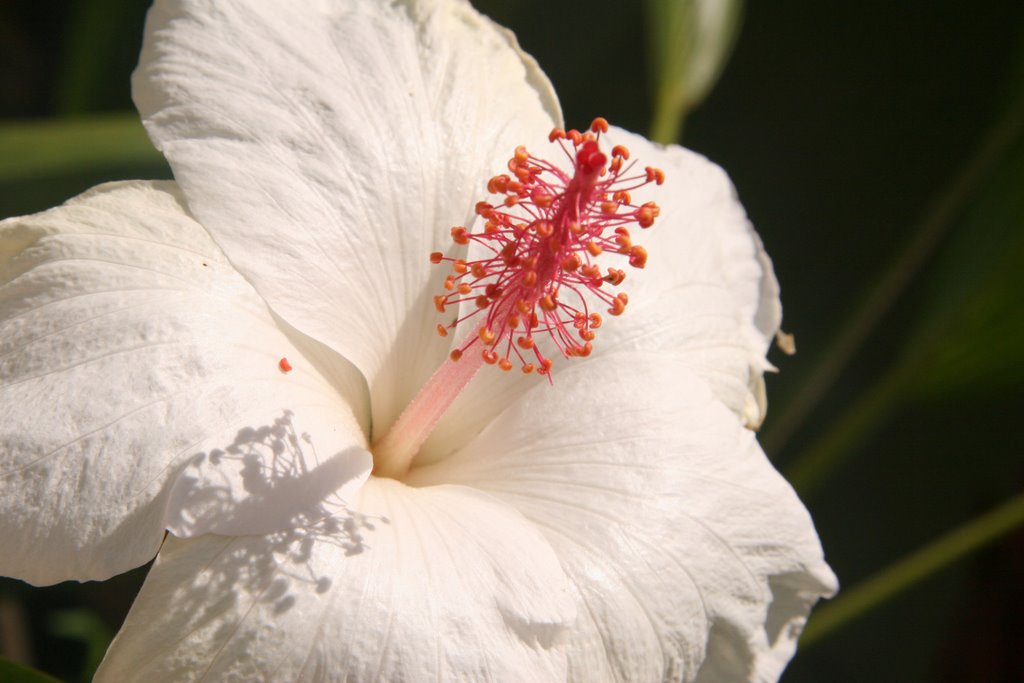
Hibiscus
by Pam Woolway
I never gave you a second glance;
scrappy, gangly hedge.
We met in California,
where the air is cracker-dry.
You were all bony hips and elbows,
interrupted by green leaf
and only an occasional bloom.
How wrong I was,
Senorita Hibiscus,
parachutes of color prostitute
themselves to bees and butterflies.
The buttery length of your
stamen, aptly approves
of bee legs and bee bottoms
to nudge, lift and probe
the long column of throat
that leads down to microscopic ova..
Your flowers are clownishly huge
and you wear your leaves,
you wear them like a flotilla
or the ruffled skirt of an Orisha;
all fabric layers and brown legs
with a face that dares the sun.
The wind tugs at your
soft petals, big ears of a beloved child.
And, oh what a nose!
You are not a shy flower.
Two hours ago
the hot pink of your playera,
tight as a Cuban cigar,
uncoiled.
But, tomorrow,
the seduction is over;
a flaccid wet ribbon,
spent and gray,
stares glumly at the grass.
I never gave you a second glance;
scrappy, gangly hedge.
We met in California,
where the air is cracker-dry.
You were all bony hips and elbows,
interrupted by green leaf
and only an occasional bloom.
How wrong I was,
Senorita Hibiscus,
parachutes of color prostitute
themselves to bees and butterflies.
The buttery length of your
stamen, aptly approves
of bee legs and bee bottoms
to nudge, lift and probe
the long column of throat
that leads down to microscopic ova..
Your flowers are clownishly huge
and you wear your leaves,
you wear them like a flotilla
or the ruffled skirt of an Orisha;
all fabric layers and brown legs
with a face that dares the sun.
The wind tugs at your
soft petals, big ears of a beloved child.
And, oh what a nose!
You are not a shy flower.
Two hours ago
the hot pink of your playera,
tight as a Cuban cigar,
uncoiled.
But, tomorrow,
the seduction is over;
a flaccid wet ribbon,
spent and gray,
stares glumly at the grass.
Wednesday, July 05, 2006
Earth Mover and Earth Tender
by Juan Wilson
Author's note: This story was written in 1993 about a place that if turned inside-out, is a lot like Kauai. The setting was Chautauqua Lake in Chautauqua County, New York, a place where a small body of water is surrounded by an ocean of land--instead of the other way around. This cautionary tale seems, unfortunately, to apply just as aptly to Kauai. This piece was originally published in "The Gobbler,'" a newsletter published by my wife and I.
Once upon a time a couple lived together just as you might find couples living today, except they weren't folks like you or me. You see they weren't folks at all, although one of them was much like a woman. She was the Earth Tender. The other was much like a man. He was the Earth Mover.
Some people today might say they were gods. Well, nothing could be farther from the truth. They hadn't made the world. They just lived in it and to some degree changed it. Other people might call them giants and make up fairy tales about them. But they weren't really the giants of fairytales either, although they were big and could get a lot done in one day if they set their minds to it.
Earth Mover and Earth Tender spent most of their days working and their nights relaxing and having fun. During the day they worked on current projects. Sometimes they worked together, and sometimes apart. Often they worked on different parts of the same project.
At night they would rest. Most nights they would talk about what they had done that day, or their plans for the next day. They talked as they watched the sky while the world revolved slowly across the moon and stars. Earth Tender especially liked it when Earth Mover told funny stories about his day's work. Earth Mover liked best hearing from Earth Tender about what a good job they were doing and how much she loved doing it.
Their jobs consisted of making the world beautiful and a better place to live in. They searched the world for unfinished places, and places that could stand a little improving. It was hard work, but it had its satisfactions. Earth Mover usually started the new projects they worked on together. If he was in a lake building mood when he woke in the morning, he might spend half the day wading through a virgin timber forest as high as his waist until he found just the right spot. When he found it he would check around the site to see if his first intuition about the place was right, and then he would begin work.
Once he started it was hard to distract him. He would work in a frenzy. He'd kick down rows of trees. He'd scoop out the earth in a broad flat bowl-shape with his bare hands. He'd pitch unwanted boulders over his shoulder. He'd pack the ground hard and flat with his feet. Finally, he'd use a large tree trunk to scratch out new paths for the surrounding streams. When he was done he would sit down leaning against the trees at the edge of the forest. For a while he'd watch the streams trickling in to fill his new creation. Then he'd usually fall asleep. He called this napping.
Often this is how Earth Tender would find him. She'd come across Earth Mover during one of his siestas. That's when she'd begin her work on the project. In the case of a lake, Earth Tender would usually start at the bottom, planting grasses and weeds to feed the fish and other creatures who would live in the lake. She'd mend the rough edges of the shoreline where there were dead stumps. She'd hide them in fresh cattails. She'd spend hours planting wild meadow flowers and find the best places to put little sandy beaches. She'd even smooth out the jagged broken stones, turning them to rounded pebbles. She'd cover the boulders with moss and lichen. By the time Earth Mover woke from his nap she'd be done and ducks would be landing in the sparkling water, and the deer would be sniffing its coolness from beyond the tree line.
Earth Tender will tell you, as nice as Earth Mover's work was, he'd always leave a real mess behind him. Sometimes he'd leave muddy streams behind him all stirred up. She'd calm them down and make them clear again. Sometimes when he was working on new land he'd underestimate things and cover much of a newly finished rain forest with steaming lava. You can be sure, if you've never dealt with steaming lava, its quite a mess.
"Oops!" he'd say, and look at her out of the corner of his downcast eye. Then she'd have her hands full.
Although Earth Mover would never say so, Earth Tender had a tendency to go a little overboard in her own way. She seemed to have a weakness for bright colors. Occasionally she'd just smother a hillside in magenta petalled flowers, and Earth Mover would just shake his head. And if a particular creature pleased her, she'd just make millions of them. Sometimes it was bunnies, other times butterflies. It usually fell on Earth Mover to fix things up if they got way out of hand. Like with the dinosaurs. They were just too damn big. If things got too bad he usually made it very dry, or very wet, or very cold, or very hot for a while and then the trouble would just go away on its own.
Earth Mover and Earth Tender passed century after century working together this way, and thousands of years passed. All in all, the world was getting more beautiful all the time. He would cut and fill the hillsides and she would blanket them with life. They were both very happy. But, as is usually the case when things are just about right, trouble was coming.
It all had to do with the people. Oh yes, people were around even then. There weren't many of them. Mostly they ran around with pointed sticks yelling at each other. At night the people made fires and told scary stories to each other. They didn't know much about Earth Mover and Earth Tender and didn't care. Frankly, this was because they were stupid.
Of Earth Mover's work they would say:?"What did we do to deserve this?" or "Maybe it's God's will!"
Of Earth Tender's forest work they would say:?"Cut 'em all down! Don't worry, they'll grow back."
Or sometimes, when pressed about a nasty mistake, they would say:?"Time heals all wounds."
They went about hunting down everything in sight and making at least as much of a mess as Earth Mover himself. When a place was ruined they would simply move on to the next place.
As I said, they were pretty stupid. But Earth Tender had taken quite a liking to the little creatures anyway. When Earth Mover wasn't around she'd make sure it was easier for them to get along in the world. She thought it was cute the way they fell in love and cared for their young. Soon the little pests were everywhere.
She spent time that might have been otherwise used to complete unfinished projects, to make sure people had plenty of animals to hunt and plenty of nearby fruit trees to pick. Instead of planting a sturdy stand of trees against the rough alpine slope of a new mountain, she'd be watching her pets build bigger villages.
None of this was of serious concern to Earth Mover... until they started getting underfoot. One blissful summer evening he was just settling back to rest. He planned to tell Earth Tender a particularly funny adventure he'd had while carving a cliff face for a new waterfall. Then it happened. A group of people had made a big fire right behind him. First he smelled the smoke. It reeked of burnt game. Next the smoke was in his eye. Confused, he roared and tried to roll away. In so doing he crushed out the fire and several of the little creatures as well.
Earth Tender was furious. She called him a brute. Unfeeling. Insensitive. Earth Mover felt terrible. So next, he tried to rebuild the fire for the people that survived and only succeeded in burning down a fairly large section of forest. Earth Tender didn't speak to him for a week. And the people were furious too. They had never been too happy with his work anyway. Soon they were calling him a wrathful god. A fire god. A thunder god. A volcano god. An earthquake god. As Earth Mover saw it, he wasn't a god... Just a guy trying to get his job done.
To make up to Earth Tender he tried to stay as far away from people as possible. He walked far from their settlements to start his day's work. These hikes to distant places must have inspired him, for he did some of his most dramatic and breathtaking work in these remote parts of the world. But staying out of the way of people proved impossible. Earth Mover couldn't even finish a new part of the world before the people were underfoot again. They would make more fires and wave even sharper sticks at each other and occasionally even torture one of their own number thinking this would make Earth Mover happy. He thought they were crazy.
As their numbers grew, the people spread out, moving into more of the earth's places. This began to be a real chore for Earth Tender. Now she was spending half her time trying to clean up after new cute little people in places she had thought were just about perfect until they arrived. Earth Mover and Earth Tender began to argue a lot. He said she wasn't getting her work done. She said he didn't care about anything but himself.
Finally, one night when Earth Mover was feeling tense and unhappy about the way things were going, Earth Tender asked, "What's wrong with you? Are you upset? Tell me what you're feeling."
At first Earth Mover was silent. He knew that by asking him what he was feeling usually meant she was going to argue with him. But this time he sensed something different about Earth Tender. So, he decided to go into it one more time.
"It's those people of yours. They're underfoot all the time. They are making a holy-hell of the places we completed millennia ago. New work is getting almost impossible to do. Those people are even moving into unfinished areas. They seem willing to live anywhere, as if it didn't matter where they were. To get anything done now I'd have to flood their overflowing villages, or bury their teeming cities."
When he finished he hunkered down, waiting for her angry words. But they didn't come. Now it was her turn to be silent for a moment.
She turned to him and said,?"You're right. I've known for some time that they were spoiling their own nests and ruining things for other creatures. There are too many of them and they don't seem to know what they are doing. Sometimes I even think they may be stupid or something. They certainly don't seem so cute when there are so many of them."
"Okay! Let me turn the heat up on them then," he interrupted.
"Not yet!" she answered, "Before we do anything rash, let me talk to them. If they won't listen to me then we'll just start all over again. And this time, if there are any people, we will make sure they don't spread around so much, make such a mess or ruin the fun for all the others."
Earth Mover was glad to hear this and drifted off to sleep, dreaming about digging out a valley he'd been thinking about in his spare moments. Earth Tender was glad too. She resolved to get up early the next morning to tell the little creatures about the new rules. As she drifted off she was sure they would listen.
The End
Juan Wilson says he is a recovering suburbanite active in trying to slow growth and make the island of Kauai self-sustaining. He resides in Hanapepe, where he and his wife edit the website www.islandbreath.org
Author's note: This story was written in 1993 about a place that if turned inside-out, is a lot like Kauai. The setting was Chautauqua Lake in Chautauqua County, New York, a place where a small body of water is surrounded by an ocean of land--instead of the other way around. This cautionary tale seems, unfortunately, to apply just as aptly to Kauai. This piece was originally published in "The Gobbler,'" a newsletter published by my wife and I.
Once upon a time a couple lived together just as you might find couples living today, except they weren't folks like you or me. You see they weren't folks at all, although one of them was much like a woman. She was the Earth Tender. The other was much like a man. He was the Earth Mover.
Some people today might say they were gods. Well, nothing could be farther from the truth. They hadn't made the world. They just lived in it and to some degree changed it. Other people might call them giants and make up fairy tales about them. But they weren't really the giants of fairytales either, although they were big and could get a lot done in one day if they set their minds to it.
Earth Mover and Earth Tender spent most of their days working and their nights relaxing and having fun. During the day they worked on current projects. Sometimes they worked together, and sometimes apart. Often they worked on different parts of the same project.
At night they would rest. Most nights they would talk about what they had done that day, or their plans for the next day. They talked as they watched the sky while the world revolved slowly across the moon and stars. Earth Tender especially liked it when Earth Mover told funny stories about his day's work. Earth Mover liked best hearing from Earth Tender about what a good job they were doing and how much she loved doing it.
Their jobs consisted of making the world beautiful and a better place to live in. They searched the world for unfinished places, and places that could stand a little improving. It was hard work, but it had its satisfactions. Earth Mover usually started the new projects they worked on together. If he was in a lake building mood when he woke in the morning, he might spend half the day wading through a virgin timber forest as high as his waist until he found just the right spot. When he found it he would check around the site to see if his first intuition about the place was right, and then he would begin work.
Once he started it was hard to distract him. He would work in a frenzy. He'd kick down rows of trees. He'd scoop out the earth in a broad flat bowl-shape with his bare hands. He'd pitch unwanted boulders over his shoulder. He'd pack the ground hard and flat with his feet. Finally, he'd use a large tree trunk to scratch out new paths for the surrounding streams. When he was done he would sit down leaning against the trees at the edge of the forest. For a while he'd watch the streams trickling in to fill his new creation. Then he'd usually fall asleep. He called this napping.
Often this is how Earth Tender would find him. She'd come across Earth Mover during one of his siestas. That's when she'd begin her work on the project. In the case of a lake, Earth Tender would usually start at the bottom, planting grasses and weeds to feed the fish and other creatures who would live in the lake. She'd mend the rough edges of the shoreline where there were dead stumps. She'd hide them in fresh cattails. She'd spend hours planting wild meadow flowers and find the best places to put little sandy beaches. She'd even smooth out the jagged broken stones, turning them to rounded pebbles. She'd cover the boulders with moss and lichen. By the time Earth Mover woke from his nap she'd be done and ducks would be landing in the sparkling water, and the deer would be sniffing its coolness from beyond the tree line.
Earth Tender will tell you, as nice as Earth Mover's work was, he'd always leave a real mess behind him. Sometimes he'd leave muddy streams behind him all stirred up. She'd calm them down and make them clear again. Sometimes when he was working on new land he'd underestimate things and cover much of a newly finished rain forest with steaming lava. You can be sure, if you've never dealt with steaming lava, its quite a mess.
"Oops!" he'd say, and look at her out of the corner of his downcast eye. Then she'd have her hands full.
Although Earth Mover would never say so, Earth Tender had a tendency to go a little overboard in her own way. She seemed to have a weakness for bright colors. Occasionally she'd just smother a hillside in magenta petalled flowers, and Earth Mover would just shake his head. And if a particular creature pleased her, she'd just make millions of them. Sometimes it was bunnies, other times butterflies. It usually fell on Earth Mover to fix things up if they got way out of hand. Like with the dinosaurs. They were just too damn big. If things got too bad he usually made it very dry, or very wet, or very cold, or very hot for a while and then the trouble would just go away on its own.
Earth Mover and Earth Tender passed century after century working together this way, and thousands of years passed. All in all, the world was getting more beautiful all the time. He would cut and fill the hillsides and she would blanket them with life. They were both very happy. But, as is usually the case when things are just about right, trouble was coming.
It all had to do with the people. Oh yes, people were around even then. There weren't many of them. Mostly they ran around with pointed sticks yelling at each other. At night the people made fires and told scary stories to each other. They didn't know much about Earth Mover and Earth Tender and didn't care. Frankly, this was because they were stupid.
Of Earth Mover's work they would say:?"What did we do to deserve this?" or "Maybe it's God's will!"
Of Earth Tender's forest work they would say:?"Cut 'em all down! Don't worry, they'll grow back."
Or sometimes, when pressed about a nasty mistake, they would say:?"Time heals all wounds."
They went about hunting down everything in sight and making at least as much of a mess as Earth Mover himself. When a place was ruined they would simply move on to the next place.
As I said, they were pretty stupid. But Earth Tender had taken quite a liking to the little creatures anyway. When Earth Mover wasn't around she'd make sure it was easier for them to get along in the world. She thought it was cute the way they fell in love and cared for their young. Soon the little pests were everywhere.
She spent time that might have been otherwise used to complete unfinished projects, to make sure people had plenty of animals to hunt and plenty of nearby fruit trees to pick. Instead of planting a sturdy stand of trees against the rough alpine slope of a new mountain, she'd be watching her pets build bigger villages.
None of this was of serious concern to Earth Mover... until they started getting underfoot. One blissful summer evening he was just settling back to rest. He planned to tell Earth Tender a particularly funny adventure he'd had while carving a cliff face for a new waterfall. Then it happened. A group of people had made a big fire right behind him. First he smelled the smoke. It reeked of burnt game. Next the smoke was in his eye. Confused, he roared and tried to roll away. In so doing he crushed out the fire and several of the little creatures as well.
Earth Tender was furious. She called him a brute. Unfeeling. Insensitive. Earth Mover felt terrible. So next, he tried to rebuild the fire for the people that survived and only succeeded in burning down a fairly large section of forest. Earth Tender didn't speak to him for a week. And the people were furious too. They had never been too happy with his work anyway. Soon they were calling him a wrathful god. A fire god. A thunder god. A volcano god. An earthquake god. As Earth Mover saw it, he wasn't a god... Just a guy trying to get his job done.
To make up to Earth Tender he tried to stay as far away from people as possible. He walked far from their settlements to start his day's work. These hikes to distant places must have inspired him, for he did some of his most dramatic and breathtaking work in these remote parts of the world. But staying out of the way of people proved impossible. Earth Mover couldn't even finish a new part of the world before the people were underfoot again. They would make more fires and wave even sharper sticks at each other and occasionally even torture one of their own number thinking this would make Earth Mover happy. He thought they were crazy.
As their numbers grew, the people spread out, moving into more of the earth's places. This began to be a real chore for Earth Tender. Now she was spending half her time trying to clean up after new cute little people in places she had thought were just about perfect until they arrived. Earth Mover and Earth Tender began to argue a lot. He said she wasn't getting her work done. She said he didn't care about anything but himself.
Finally, one night when Earth Mover was feeling tense and unhappy about the way things were going, Earth Tender asked, "What's wrong with you? Are you upset? Tell me what you're feeling."
At first Earth Mover was silent. He knew that by asking him what he was feeling usually meant she was going to argue with him. But this time he sensed something different about Earth Tender. So, he decided to go into it one more time.
"It's those people of yours. They're underfoot all the time. They are making a holy-hell of the places we completed millennia ago. New work is getting almost impossible to do. Those people are even moving into unfinished areas. They seem willing to live anywhere, as if it didn't matter where they were. To get anything done now I'd have to flood their overflowing villages, or bury their teeming cities."
When he finished he hunkered down, waiting for her angry words. But they didn't come. Now it was her turn to be silent for a moment.
She turned to him and said,?"You're right. I've known for some time that they were spoiling their own nests and ruining things for other creatures. There are too many of them and they don't seem to know what they are doing. Sometimes I even think they may be stupid or something. They certainly don't seem so cute when there are so many of them."
"Okay! Let me turn the heat up on them then," he interrupted.
"Not yet!" she answered, "Before we do anything rash, let me talk to them. If they won't listen to me then we'll just start all over again. And this time, if there are any people, we will make sure they don't spread around so much, make such a mess or ruin the fun for all the others."
Earth Mover was glad to hear this and drifted off to sleep, dreaming about digging out a valley he'd been thinking about in his spare moments. Earth Tender was glad too. She resolved to get up early the next morning to tell the little creatures about the new rules. As she drifted off she was sure they would listen.
The End
Juan Wilson says he is a recovering suburbanite active in trying to slow growth and make the island of Kauai self-sustaining. He resides in Hanapepe, where he and his wife edit the website www.islandbreath.org
Wednesday, June 28, 2006
Walt Whitman says...
“Now I see the secret of the making of the best persons,
It is to grow in the open air and to eat and sleep with the earth.”
Walt Whitman, Leaves of Grass
It is to grow in the open air and to eat and sleep with the earth.”
Walt Whitman, Leaves of Grass
Tuesday, June 20, 2006
A Note from Auntie Logy
On Menehunes
by Gae Rusk
Auntie Logy once believed everything flight attendants said, but that was when they were called stewardesses. Their job appears the same now, same duties, same benefits, and they still make instructional announcements when a flight enters Hawaii air space, usually glib accounts of Captain Cook discovering these islands. Coming into Kauai, flight attendants often announce that magical elves called Menehune still haunt Kauai. Auntie once believed this information, but now Auntie knows history as told by flight attendants is suspect.
Yep, Auntie is done with listening to HVB’s and KVB’s theme park lies. It is mostly inaccurate and completely insulting information, aimed at a childish, ignorant type of Visitor who possibly doesn’t even exist anymore in this info-saturated, well-traveled era.
Isn’t it time to stop trivializing Hawaii in general and Kauai in particular? This thought stimulated Auntie. This thought made Auntie squirm on the library chair when researching for information. This thought kept Auntie looking into discoveries by archeologists in Oceania and studying details found in Polynesian chants.
It was fun. It was healthy too, because, unlike when watching television, Auntie does not eat Cheetos when reading. So, from all Auntie Logy’s research, here are a few historical facts to replace that drivel now spouted with such authority at every arrival.
First, Captain Cook was a latecomer to these islands. True. Even the Spanish passed through here before he did. Traveling between California and Asia, the Spanish impacted Hawaiians at least two hundred years before Cook’s gnarly, diseased crew landed, and there are Spanish maps and Hawaiian oral history to prove this.
Second, Tahitian warrior/explorers landed on these shores at least six centuries before the Spanish. These ali’i surging north from the Society Islands were powerful and sophisticated voyagers looking to claim and conquer, but even they were not the first to reach Kauai.
Third, the first people to reach Kauai were very probably the Menehune voyaging out of the Marquesas. Auntie discovered the Kauaian word menehune is uncannily similar to the Marquesan word manahune, which means “common man”, and not “little man”. This explains so much! Other evidence indicates the Marquesas suffered reoccurring drought, and drought was a major impetus for Polynesian migration. Oral history and linguistics indicate Marquesans sailed northwest, following the birds as they migrated, thinking there must be land in that direction and maybe it would have fresh water.
Before the Menehune arrived, who knows. There is a lot of wishful thinking, but no way to tell for sure, although personally Auntie favors clues indicating Polynesians first voyaged west out of South America. Anyway, the point is, when ali’i from Tahiti reached Kauai, they found a population already established. They found farmers and fishermen, common men, whom they drove into remote valleys, where they either died out or were assimilated into the newer culture.
Somehow, this wonderful, complex, fascinating history got all turned around by late arrivals - otherwise called revisionists – so it became Cook who discovered Hawaii, and the Menehune became a joke. The Menehune became a cartoon, which is damned insulting. To portray the First Nation of Kauai as elves on steroids? Come on! Auntie’s girlfriends, and even her bowling league too, everyone thinks this is insulting.
Let’s look at it another way. Auntie has been in the islands full time since 1979. Let’s say the ali’i began arriving about twelve hundred years ago, which is forty times longer here than Auntie. Let’s say the Menehune arrived from the Marquesas a couple of hundred years before the ali’i, which is no less than fifty times longer here than Auntie.
But Cook? Hey, he’s recent, only ten times longer here than me. Everyone beat him here but Auntie Logy. There are even chants in Polynesia about a blonde Viking-type who beat all other Euros to the Pacific, so why in the world does James Cook get top billing?
Because he returned to Europe and published his damn journals and maps. Then, half the population of the northern hemisphere moved in or passed through Hawaii, and it was always all about them, that’s why. As to historical facts that weren’t convenient, or were misunderstood, or were too complex to tell easily, well, it seems history got highjacked and dumbed-down and fed back to us by Visitors as the gospel truth.
Auntie now knows all those details were twisted into pretzels that favored the published. This means returning to the sources of cultural knowledge and studying the evidence of scientific analysis to find all that original information and have any chance at truth. Lucky this Auntie has one stubborn streak to know the facts, all the facts and just the facts, so it actually worked out well.
Now Auntie says shame on all revisers of history, and shame on us for letting it happen. Shame on HVB and KVB for sustaining lazy myths. Shame on flight attendants for repeating them, and shame on Visitors for not asking if those pre-landing announcements are some sort of joke. So much shame, this island. Is Auntie the only one thinking this?
Is there some Marketeer at KVB who would care to re-introduce Kauai to the world, this time with dignity and integrity and accuracy? If so, may the island’s God of Truth bless you forever.
There now, Auntie Logy spoke her mind. Auntie feels much better. A hui hou.
Please note: Antilogy is an inconsistency or contradiction in terms or ideas, causing controversy and discussion.
Gae Rusk copyright 2006
by Gae Rusk
Auntie Logy once believed everything flight attendants said, but that was when they were called stewardesses. Their job appears the same now, same duties, same benefits, and they still make instructional announcements when a flight enters Hawaii air space, usually glib accounts of Captain Cook discovering these islands. Coming into Kauai, flight attendants often announce that magical elves called Menehune still haunt Kauai. Auntie once believed this information, but now Auntie knows history as told by flight attendants is suspect.
Yep, Auntie is done with listening to HVB’s and KVB’s theme park lies. It is mostly inaccurate and completely insulting information, aimed at a childish, ignorant type of Visitor who possibly doesn’t even exist anymore in this info-saturated, well-traveled era.
Isn’t it time to stop trivializing Hawaii in general and Kauai in particular? This thought stimulated Auntie. This thought made Auntie squirm on the library chair when researching for information. This thought kept Auntie looking into discoveries by archeologists in Oceania and studying details found in Polynesian chants.
It was fun. It was healthy too, because, unlike when watching television, Auntie does not eat Cheetos when reading. So, from all Auntie Logy’s research, here are a few historical facts to replace that drivel now spouted with such authority at every arrival.
First, Captain Cook was a latecomer to these islands. True. Even the Spanish passed through here before he did. Traveling between California and Asia, the Spanish impacted Hawaiians at least two hundred years before Cook’s gnarly, diseased crew landed, and there are Spanish maps and Hawaiian oral history to prove this.
Second, Tahitian warrior/explorers landed on these shores at least six centuries before the Spanish. These ali’i surging north from the Society Islands were powerful and sophisticated voyagers looking to claim and conquer, but even they were not the first to reach Kauai.
Third, the first people to reach Kauai were very probably the Menehune voyaging out of the Marquesas. Auntie discovered the Kauaian word menehune is uncannily similar to the Marquesan word manahune, which means “common man”, and not “little man”. This explains so much! Other evidence indicates the Marquesas suffered reoccurring drought, and drought was a major impetus for Polynesian migration. Oral history and linguistics indicate Marquesans sailed northwest, following the birds as they migrated, thinking there must be land in that direction and maybe it would have fresh water.
Before the Menehune arrived, who knows. There is a lot of wishful thinking, but no way to tell for sure, although personally Auntie favors clues indicating Polynesians first voyaged west out of South America. Anyway, the point is, when ali’i from Tahiti reached Kauai, they found a population already established. They found farmers and fishermen, common men, whom they drove into remote valleys, where they either died out or were assimilated into the newer culture.
Somehow, this wonderful, complex, fascinating history got all turned around by late arrivals - otherwise called revisionists – so it became Cook who discovered Hawaii, and the Menehune became a joke. The Menehune became a cartoon, which is damned insulting. To portray the First Nation of Kauai as elves on steroids? Come on! Auntie’s girlfriends, and even her bowling league too, everyone thinks this is insulting.
Let’s look at it another way. Auntie has been in the islands full time since 1979. Let’s say the ali’i began arriving about twelve hundred years ago, which is forty times longer here than Auntie. Let’s say the Menehune arrived from the Marquesas a couple of hundred years before the ali’i, which is no less than fifty times longer here than Auntie.
But Cook? Hey, he’s recent, only ten times longer here than me. Everyone beat him here but Auntie Logy. There are even chants in Polynesia about a blonde Viking-type who beat all other Euros to the Pacific, so why in the world does James Cook get top billing?
Because he returned to Europe and published his damn journals and maps. Then, half the population of the northern hemisphere moved in or passed through Hawaii, and it was always all about them, that’s why. As to historical facts that weren’t convenient, or were misunderstood, or were too complex to tell easily, well, it seems history got highjacked and dumbed-down and fed back to us by Visitors as the gospel truth.
Auntie now knows all those details were twisted into pretzels that favored the published. This means returning to the sources of cultural knowledge and studying the evidence of scientific analysis to find all that original information and have any chance at truth. Lucky this Auntie has one stubborn streak to know the facts, all the facts and just the facts, so it actually worked out well.
Now Auntie says shame on all revisers of history, and shame on us for letting it happen. Shame on HVB and KVB for sustaining lazy myths. Shame on flight attendants for repeating them, and shame on Visitors for not asking if those pre-landing announcements are some sort of joke. So much shame, this island. Is Auntie the only one thinking this?
Is there some Marketeer at KVB who would care to re-introduce Kauai to the world, this time with dignity and integrity and accuracy? If so, may the island’s God of Truth bless you forever.
There now, Auntie Logy spoke her mind. Auntie feels much better. A hui hou.
Please note: Antilogy is an inconsistency or contradiction in terms or ideas, causing controversy and discussion.
Gae Rusk copyright 2006
Sunday, June 11, 2006
Leaving Legacies
[Editors' note: Please help us finish the last line of this poem. Simply click on "comments" to submit your suggestion.]
by Kim Steutermann Rogers
What do you want to be when you grow up?
Robert wants to be an environmental lawyer.
Paul wants to be an organic farmer.
Jean-Michel wants to save the oceans.
What do you want to be when you grow up?
Sally wants to adopt all the world’s children.
Bono wants to feed them.
Oprah wants to cure them of AIDS.
What do you want to be when you grow up?
Toyota wants to be green.
Dove wants to build girls esteem.
BP wants to be beyond petroleum.
What do you want to be when you grow up?
Switzerland wants to be neutral.
Brazil wants to be self sufficient.
Greenfield, Massachusetts; Bennington, Vermont; Santa Cruz and San Francisco, California want to be Big Box free.
Kauai wants to be…?
by Kim Steutermann Rogers
What do you want to be when you grow up?
Robert wants to be an environmental lawyer.
Paul wants to be an organic farmer.
Jean-Michel wants to save the oceans.
What do you want to be when you grow up?
Sally wants to adopt all the world’s children.
Bono wants to feed them.
Oprah wants to cure them of AIDS.
What do you want to be when you grow up?
Toyota wants to be green.
Dove wants to build girls esteem.
BP wants to be beyond petroleum.
What do you want to be when you grow up?
Switzerland wants to be neutral.
Brazil wants to be self sufficient.
Greenfield, Massachusetts; Bennington, Vermont; Santa Cruz and San Francisco, California want to be Big Box free.
Kauai wants to be…?
Monday, June 05, 2006
Remembering Lawai Valley
[Editors' note: This piece originally ran in the Honolulu Advertiser.]
by Mahealani Perez-Wendt
My corner of the world began with the bounty of a family garden, ranged beyond it to fruit-laden trees in a yard unremarkable for this part of the country, and extended to wild orchards tantalizing from low rolling hills to Norfolk mountains.
In the garden, a tangled vineyard of cherry tomatoes spilled over its lattice onto rows of chickpeas, carrots, radishes, green onions, and many other edibles. These were hedged in by the dense foliage of Surinam with its tart, pumpkin-shaped fruit, protecting against burrowing animals like Junior, our pet mountain pig.
There were mango, banana, avocado, and sprawling mountain apple trees, strategic blinds to friendly but sometimes overly-inquisitive neighbors who vigilently reconnoitered vehicles traveling the jeep road in and out of the valley.
Thickets of wild tangerine, oranges, strawberry guava and roseapple grew along the hillside. Green tendrils of liliko`i hoisted above kukui nut trees, forming arbors with topmost branches. Wild achote, oregano and cilantro grew in abundance, planted by my grandparents many years before.
There were flowers and ornamentals in the yard manicured by my Hawaiian mother – roses, calla lillies, ice pink akulikuli, canna, gardenia, hibiscus, innumerable varieties of ti and Hawaiian medicinal plants.
The roadside displayed miniature bouquets of fiery lantana, and lavender curls of manaloa hung from weathered fenceposts.
A stream traversed the pasture beyond our garden, its banks choked with reedy Job’s Tears and succulent white ginger. An old stonewall still assembled, its crevices ablossom with shell-pink and orange flowers. They were cheerful and resonating in the sun, a subtle aurora at day’s end. Eucalyptus, white paperbark and hau – these sentinels added to the magic beyond our garden.
Across the stream, an aging Auntie Louisa and Uncle Dionicio sunned themselves on their front porch, contentedly smoking black twists of Toscani. Their home smelled of freshly baked bread, and not infrequently, she stood on the porch, singing out and calling to everyone within earshot to come for fresh malasadas.
There were rituals of men, rituals of women. The men were consummate hunters, skilled with horses, livestock and cattle. My earliest memories were of tall, dark men in black saddles with leather riding crops and boots. The children were weaned on horses and cattle; they understood roping, branding, methods of slaughter. They listened as their fathers swapped hunting stories – some chilling, others full of country humor.
The women often worked as seasonal trimmers at nearby Lawa`i cannery, and were skilled with knives and techniques of butchery. The slaughter of animals occasioned a marathon of activity – cutting, sorting, wrapping, labeling and provisioning for families as well as market.
Sometimes they would gather to make sausages. At these times, the women would don kerchieves and spend the entire day bent over heaps of hot, savory spices and mountains of onions, peppers, parsley, garlic and pork for mosilla and linquesa.
This was a community of devout Catholics, and there were many discussions about church and the holy sacraments. How does one pray a soul out of purgatory? I wondered about these things.
There were festive celebrations and revelry with special wines, wonderful food, “katchi-katchi” music and of course, lively dancing. Everybody cut loose. I remember my uncles putting on their wives’ clothes, including brassieres, and dancing the rhumba. Unbelievable.
On some Saturday nights, families piled into jeeps and Model A’s for John Wayne movies at Kalaheo Theater. At these times, a great cheer would go up when the calvary galloped in against “redskins”. Times sure have changed.
It seems a child’s life in Lawa`i was an idyll of dreams – hours spent catching crayfish with guava branches and string; hours sitting on topmost branches of trees with forbidden shakers of shoyu, salt and pepper; exploring every trail, every fence, every foot bridge; knowing special rocks and secret places – we passed our time this way. We learned about family and kinship, and from the earth, we learned our place.
by Mahealani Perez-Wendt
My corner of the world began with the bounty of a family garden, ranged beyond it to fruit-laden trees in a yard unremarkable for this part of the country, and extended to wild orchards tantalizing from low rolling hills to Norfolk mountains.
In the garden, a tangled vineyard of cherry tomatoes spilled over its lattice onto rows of chickpeas, carrots, radishes, green onions, and many other edibles. These were hedged in by the dense foliage of Surinam with its tart, pumpkin-shaped fruit, protecting against burrowing animals like Junior, our pet mountain pig.
There were mango, banana, avocado, and sprawling mountain apple trees, strategic blinds to friendly but sometimes overly-inquisitive neighbors who vigilently reconnoitered vehicles traveling the jeep road in and out of the valley.
Thickets of wild tangerine, oranges, strawberry guava and roseapple grew along the hillside. Green tendrils of liliko`i hoisted above kukui nut trees, forming arbors with topmost branches. Wild achote, oregano and cilantro grew in abundance, planted by my grandparents many years before.
There were flowers and ornamentals in the yard manicured by my Hawaiian mother – roses, calla lillies, ice pink akulikuli, canna, gardenia, hibiscus, innumerable varieties of ti and Hawaiian medicinal plants.
The roadside displayed miniature bouquets of fiery lantana, and lavender curls of manaloa hung from weathered fenceposts.
A stream traversed the pasture beyond our garden, its banks choked with reedy Job’s Tears and succulent white ginger. An old stonewall still assembled, its crevices ablossom with shell-pink and orange flowers. They were cheerful and resonating in the sun, a subtle aurora at day’s end. Eucalyptus, white paperbark and hau – these sentinels added to the magic beyond our garden.
Across the stream, an aging Auntie Louisa and Uncle Dionicio sunned themselves on their front porch, contentedly smoking black twists of Toscani. Their home smelled of freshly baked bread, and not infrequently, she stood on the porch, singing out and calling to everyone within earshot to come for fresh malasadas.
There were rituals of men, rituals of women. The men were consummate hunters, skilled with horses, livestock and cattle. My earliest memories were of tall, dark men in black saddles with leather riding crops and boots. The children were weaned on horses and cattle; they understood roping, branding, methods of slaughter. They listened as their fathers swapped hunting stories – some chilling, others full of country humor.
The women often worked as seasonal trimmers at nearby Lawa`i cannery, and were skilled with knives and techniques of butchery. The slaughter of animals occasioned a marathon of activity – cutting, sorting, wrapping, labeling and provisioning for families as well as market.
Sometimes they would gather to make sausages. At these times, the women would don kerchieves and spend the entire day bent over heaps of hot, savory spices and mountains of onions, peppers, parsley, garlic and pork for mosilla and linquesa.
This was a community of devout Catholics, and there were many discussions about church and the holy sacraments. How does one pray a soul out of purgatory? I wondered about these things.
There were festive celebrations and revelry with special wines, wonderful food, “katchi-katchi” music and of course, lively dancing. Everybody cut loose. I remember my uncles putting on their wives’ clothes, including brassieres, and dancing the rhumba. Unbelievable.
On some Saturday nights, families piled into jeeps and Model A’s for John Wayne movies at Kalaheo Theater. At these times, a great cheer would go up when the calvary galloped in against “redskins”. Times sure have changed.
It seems a child’s life in Lawa`i was an idyll of dreams – hours spent catching crayfish with guava branches and string; hours sitting on topmost branches of trees with forbidden shakers of shoyu, salt and pepper; exploring every trail, every fence, every foot bridge; knowing special rocks and secret places – we passed our time this way. We learned about family and kinship, and from the earth, we learned our place.
Monday, May 29, 2006
Nocturnal Visitors
by Ginny Wiehardt
[Editors' note: Ginny Wiehardt is a NYC-based writer who spent last summer writing in a shack off-the-grid in Lawai Valley. This piece was originally published on her blog of the experience at http://islehop.blogspot.com.]
Last night in the middle of the night I was awakened by a lot of noise. I sleepily assumed it was the rat, which often knocks things over in the night -- she's a rather clumsy rat -- but the noise was loud and seemed to be coming from all around the house. I looked over to see if Dasher was up, but she was on her pillow, as groggy-headed as I was. I decided that we definitely had more than one rat. Then I thought to myself, "What could they be doing?" And then, after listening another moment, "They must be really big." I waited for Dasher to start up in a rat-hunting frenzy, but Dasher, smart dog that she is, only looked at me as though to say, "Well, are you going to take care of this or what?"
Meanwhile, the banging around the house intensified.
It sounded as though something was rubbing itself against the walls. The shack practically groaned. I could hear things being knocked around, though I couldn't tell exactly what things or where they were; the sound seemed to be everywhere. I picked up the flashlight and sat up in bed. I aimed it at the kitchen, giving the rats a heads up so I wouldn't actually have to see them, and then got out of bed.
Out of bed I finally started to wake up, and I realized that the sound was outside, not in the kitchen or upstairs as I had thought. My situation was made worse by the fact that I had gone to bed listening to AM radio. On Friday nights the New Zealand station and Radio Australia both broadcast rugby, so I'm left either with Japanese stations, which sometimes have programs in English, or AM talk radio. The last program I listened to before falling asleep was on the mainland, where it would have been the middle of the night. It consisted of men calling in to describe their paranormal experiences. Some of the stories were pretty entertaining, but the last one was a guy talking about the "shadow man" who had visited him at the foot of the bed. This one was actually pretty creepy, so I switched it off before hearing the end, afraid that it was going to keep me up at night.
So there I was, in the middle of the night, visions of shadow men in my head. I bravely went to my window, nonetheless, as the noise was at this point really too loud to ignore. I immediately saw something big and solid move down the hill beside the house. My first thought was that it was a man, because it did sort of look like a man sliding down a hill. I ducked down so that he wouldn't see me. As I squatted under the window in the dark, I realized that if the thing I'd seen was a man, then that meant that there were many men, all around the house -- that the shack was being invaded for some reason, which was highly unlikely. It also struck me that the thing I'd seen was too big to be a man, and then that whatever I was hearing had more than two feet.
After listening for a few seconds to confirm the fact that it was a four-footed creature, I got up and shone my flashlight out the window. Unfortunately this mostly illuminated the screen over the window and ruined my night vision. I switched the flashlight off and peered into the darkness. There I now discerned four or five giant black shapes, negative fields against the white moonlight on the yard. "My God," I thought, "that guy had a shadow man, but I've got shadow cows."
Realizing that the idea of shadow cows was crazy, I turned the flashlight back on. In the beam of the flashlight, now that I knew where to aim it, emerged cow after cow, all peering back at me, russet- and white-faced, as normal as milk carton cows, except that these had extremely guilty looks on their faces. (One of them had been busy pushing everything off the porch of my bathroom/storage shed with his head; I'm not sure what the others were up to). Their expressions, the fact that they were there at all, and the crazy things I had imagined, struck me as hilarious and I started laughing. The sound startled the guilt-ridden cows, who all began to move away, practically running at first, back to wherever they'd come from.
I regretted scaring them, and stopped laughing, to watch instead. Without the flashlight they were again made strange -- great moonsilver creatures, moving together like pilgrims toward a shared destination.
The only sound was the sound of their hooves through the grass; they moved around the house, up the hill, and through the hole in the fence that must exist, but which I haven't yet been able to find.
Sunday, May 21, 2006
A Note from Auntie Logy
On Kauai’s Hwy
by Gae Rusk
Auntie was driving home from Princeville Foodland, heading down that long, steep hill toward Kalihiwai River, when the rental car ahead of me stopped mid-bridge to photograph the waterfall. Vehicles coming downhill both directions screeched and skidded, some skewing sideways, and it was a near miss all around. Then, the car drove off like nothing had happened.
Auntie Logy was so appalled at the Visitor’s self-absorbed, hazardous behavior, Auntie followed him all the way to Kilauea Lighthouse. There Auntie parked behind his car and got out and explained why he was lucky he wasn’t singing the flat car blues.
Because of many hellish moments like this on Kauai’s Hwy, Auntie says we need to make some attempt to educate all these arriving drivers. The State of Hawaii has been rated more than once as having the worst road conditions in the USA, and Auntie Logy knows everyone driving on Kauai will agree with that. Since so many Visitors are driving these narrow, bumpy, crowded roads with us, why not bring them up to speed while they are still en route.
Believe me, Auntie has thought a lot about how to do this when toodling up the Hwy at 38 mph, tenth car in a line of twenty, all of us behind one Visitor who thinks Kauai is a giant golf course with a super-size water hazard.
The best idea Auntie came up with is for incoming airlines to tuck laminated explanations of island driving conditions into seatback pockets. Flight attendants could indicate these sheets during their safety hulas. No doubt it would be good remedial info for Kauai residents on those flights, including Auntie.
As to cruise ships arriving at Nawiliwili Harbor, it would be simple to add island driving seminars to activities at sea. Lessons could be presented between islands, and even designed for each island’s road conditions. Cautionary photos could be displayed. Once they know what driving here is really like, Visitors might stick to the K-Mart shuttle, and everyone would be better off.
Designing and implementing such a program would likely take one tedious path through Kauai’s system of getting things done, so Auntie Logy will kick start it by asking Visitors driving here to recognize a few vital clues.
One, Kauai is not a theme park. Residents driving all those pickups and SUVs are trying to get to work, or to Wilcox walk-in clinic, or to the Raider-Warrior game at Vidinha, or to Otsuka’s for the one day mattress sale. Whatever reason, the point is, local drivers are not on vacation.
Two, the Hwy is already crowded with Citizens of Kauai even before Visitors drive into the mix. In fact, the Hwy is packed with Auntie’s daughters’ cars, and the cars of all their many friends, as they drive from Nawiliwili to Starbucks, from campus to Macy’s cosmetic counters, from the Kipu turnoff to the Kauai Collision Center after running into one big pig on the Hwy.
Three, Auntie does not like to honk her horn. Auntie believes there still exists here a faint but lingering patience with visiting drivers and with each other. Auntie knows several Kauai drivers are patient with Auntie when she has stupid, careless moments on the road, but what this means is few Visitors will ever know how much and how often they offend us on our Hwy.
My position on this Hwy problem? Aunty has had enough. Some effort must be made to improve the Hwy experience, so Visitors, you need to heed a few crucial rules while you are driving on Kauai:
Is Auntie the only one thinking this? Is there any Kauai Educateer interested in developing this campaign with the Kauai Visitor Bureau? If so, may the island’s God of Transportation bless you forever.
by Gae Rusk
Auntie was driving home from Princeville Foodland, heading down that long, steep hill toward Kalihiwai River, when the rental car ahead of me stopped mid-bridge to photograph the waterfall. Vehicles coming downhill both directions screeched and skidded, some skewing sideways, and it was a near miss all around. Then, the car drove off like nothing had happened.
Auntie Logy was so appalled at the Visitor’s self-absorbed, hazardous behavior, Auntie followed him all the way to Kilauea Lighthouse. There Auntie parked behind his car and got out and explained why he was lucky he wasn’t singing the flat car blues.
Because of many hellish moments like this on Kauai’s Hwy, Auntie says we need to make some attempt to educate all these arriving drivers. The State of Hawaii has been rated more than once as having the worst road conditions in the USA, and Auntie Logy knows everyone driving on Kauai will agree with that. Since so many Visitors are driving these narrow, bumpy, crowded roads with us, why not bring them up to speed while they are still en route.
Believe me, Auntie has thought a lot about how to do this when toodling up the Hwy at 38 mph, tenth car in a line of twenty, all of us behind one Visitor who thinks Kauai is a giant golf course with a super-size water hazard.
The best idea Auntie came up with is for incoming airlines to tuck laminated explanations of island driving conditions into seatback pockets. Flight attendants could indicate these sheets during their safety hulas. No doubt it would be good remedial info for Kauai residents on those flights, including Auntie.
As to cruise ships arriving at Nawiliwili Harbor, it would be simple to add island driving seminars to activities at sea. Lessons could be presented between islands, and even designed for each island’s road conditions. Cautionary photos could be displayed. Once they know what driving here is really like, Visitors might stick to the K-Mart shuttle, and everyone would be better off.
Designing and implementing such a program would likely take one tedious path through Kauai’s system of getting things done, so Auntie Logy will kick start it by asking Visitors driving here to recognize a few vital clues.
One, Kauai is not a theme park. Residents driving all those pickups and SUVs are trying to get to work, or to Wilcox walk-in clinic, or to the Raider-Warrior game at Vidinha, or to Otsuka’s for the one day mattress sale. Whatever reason, the point is, local drivers are not on vacation.
Two, the Hwy is already crowded with Citizens of Kauai even before Visitors drive into the mix. In fact, the Hwy is packed with Auntie’s daughters’ cars, and the cars of all their many friends, as they drive from Nawiliwili to Starbucks, from campus to Macy’s cosmetic counters, from the Kipu turnoff to the Kauai Collision Center after running into one big pig on the Hwy.
Three, Auntie does not like to honk her horn. Auntie believes there still exists here a faint but lingering patience with visiting drivers and with each other. Auntie knows several Kauai drivers are patient with Auntie when she has stupid, careless moments on the road, but what this means is few Visitors will ever know how much and how often they offend us on our Hwy.
My position on this Hwy problem? Aunty has had enough. Some effort must be made to improve the Hwy experience, so Visitors, you need to heed a few crucial rules while you are driving on Kauai:
- Do not stop mid-bridge to video the river.
- Do not read maps and drive at the same time.
- Do not creep along Kauai’s Hwy where others cannot pass you, then speed up where we can, especially on the hill at the old dairy, which isn’t there any more, so you just have to know.
- Do not rush toward Hanalei Bridge to join the end of a line of cars already crossing. It is likely the other side has been waiting and is ready to go, and you could be permanently crippled by stink-eye.
- If a line of pickup trucks forms behind you, pull over at the next wide spot and let us by. If you find yourself two feet from the rusted clunker ahead, there is really no where to go, so back off.
- If you find yourself in a turn-only lane, go ahead and make the turn and figure it out later, and do not try a desperate merge back into traffic that brings us all to a stall. Auntie is thinking in particular about the Foodland to Safeway merge, now a construction zone, where Hwy anarchy rules and drivers make enemies for life.
- And, pay attention now, do not flatten Auntie Logy in any crosswalk. This is the only time Auntie is telling you this.
Is Auntie the only one thinking this? Is there any Kauai Educateer interested in developing this campaign with the Kauai Visitor Bureau? If so, may the island’s God of Transportation bless you forever.
There now, Auntie Logy spoke her mind. Auntie feels much better. A hui hou.
Please note: Used as a noun, antilogy is an inconsistency or contradiction in terms of ideas, causing controversy and discussion.
Gae Rusk, copyright 2006
Subscribe to:
Posts (Atom)


 Posts
Posts

