Sunday, July 23, 2006

A Note from Auntie Logy

[Editor's note: This is the third in a series by Gae Rusk.]

On Helicopters
by Gae Rusk

Today, seven helicopters went over Auntie Logy’s house. Each time it happened, Auntie panicked. Each time, Auntie ran down the steps and out onto the grass and hovered anxiously between farmhouse and orchard, tortured by the rotors’ whacking roar. Seven times today, Auntie’s heartbeat was sabotaged.

It is possible Auntie’s extreme reaction is due to being a citizen-veteran of two small wars. Being a citizen-veteran means Auntie has an exaggerated startle response. As a citizen-vet, Auntie fears the helicopters will fall from the sky.

This fear is real, helicopters do fall from the sky all the time. Auntie personally knows dead pilots and dead passengers from more than one helicopter crash, so it would be better if they all stayed offshore. If helicopters stayed above open water instead of above us, when they crash, which they will, at least they will land on water and not on Auntie, but helicopters give hostile excuses about needing to be over land for safety reasons.

I ask you, whose safety do they mean? Not the safety of people cowering below, that’s for sure. Not the safety of Auntie. Helicopters believe they are more important than Auntie, who lives and works at ground level. Helicopters have gotten away with this bizarre thinking, backwards thinking, opposite to logic thinking, to the point that no one knows how to stop them from chopping across the sky over our homes.

This enrages Auntie. Yes, helicopters flying over her quiet neighborhood incite rage in Auntie Logy, and not just for safety reasons. Some helicopters come over way too low, even though a minimum altitude rule exists, and Auntie’s neighbor has landed one in his front yard more than once. He did not care that Auntie had panic attacks when his machine spiralled down over her roof. None of those helicopters care that Auntie rushes outside and runs in circles with the desperate dogs, the horses next door fleeing from end to end of their pasture, eyes rolling wildly and all of us risking broken legs.

Auntie screams, “Sky scum!” at the helicopters. Hoarse from the effort, Auntie yells, “Bastards!” and Auntie vows yet again to paint this across the roof of the barn. Then, crippled by the rigor of her startle response to yet another murdering of peace and air, Auntie Logy limps inside and runs cold well water over her wrists.

Obviously, Auntie cannot stop those helicopters from going anywhere they want. They’ve had their way so long, since 1962, they claim a common law marriage with Kauai’s air space.
And Auntie cannot change the fact that living in war zones has shaped her response to helicopters. Auntie will never heal if they continue their wilful ways, violating and damaging Auntie from above. Seven times today, so far.

Is Auntie Logy the only one thinking this? Are there other citizen-vets disabled and destroyed by helicopters in our sky? Is there a County Council member who agrees with Auntie that helicopters should stay offshore? If so, may the island’s God of Peace and Quiet bless you forever.


There now, Auntie Logy spoke her mind. Auntie feels much better. A hui hou.


Please note: Antilogy is an inconsistency or contradiction in terms or ideas,
causing controversy and discussion.

Gae Rusk copyright 2006

Saturday, July 15, 2006


(c) Kim Steutermann Rogers

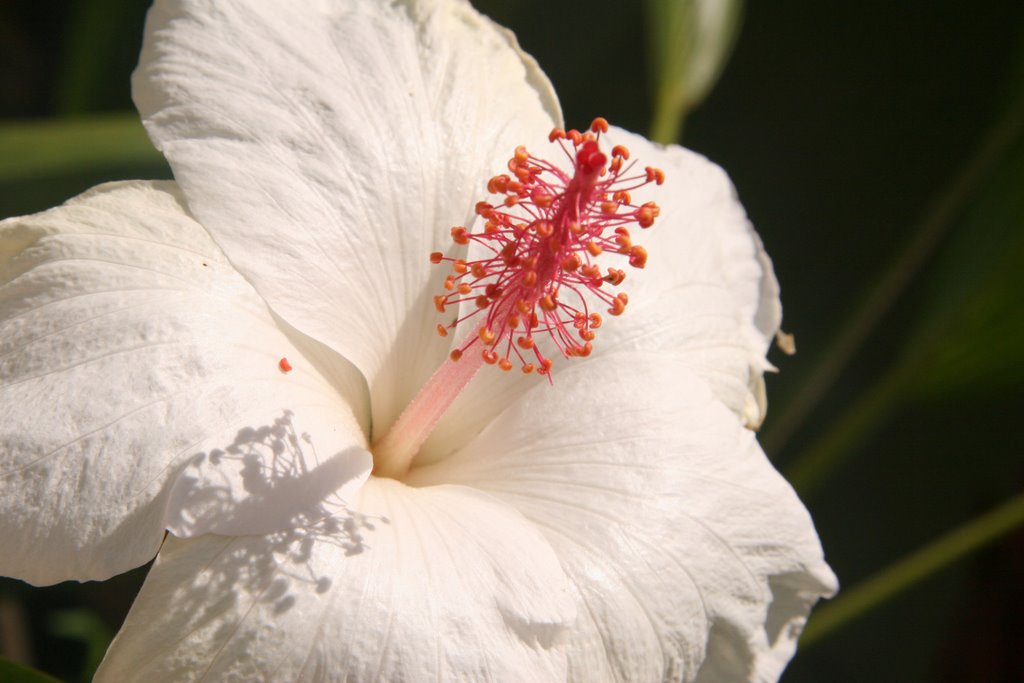
Hibiscus

by Pam Woolway

I never gave you a second glance;
scrappy, gangly hedge.
We met in California,
where the air is cracker-dry.
You were all bony hips and elbows,
interrupted by green leaf
and only an occasional bloom.
How wrong I was,
Senorita Hibiscus,
parachutes of color prostitute
themselves to bees and butterflies.
The buttery length of your
stamen, aptly approves
of bee legs and bee bottoms
to nudge, lift and probe
the long column of throat
that leads down to microscopic ova..
Your flowers are clownishly huge
and you wear your leaves,
you wear them like a flotilla
or the ruffled skirt of an Orisha;
all fabric layers and brown legs
with a face that dares the sun.
The wind tugs at your
soft petals, big ears of a beloved child.
And, oh what a nose!
You are not a shy flower.
Two hours ago
the hot pink of your playera,
tight as a Cuban cigar,
uncoiled.
But, tomorrow,
the seduction is over;
a flaccid wet ribbon,
spent and gray,
stares glumly at the grass.

Wednesday, July 05, 2006

Earth Mover and Earth Tender

by Juan Wilson

Author's note: This story was written in 1993 about a place that if turned inside-out, is a lot like Kauai. The setting was Chautauqua Lake in Chautauqua County, New York, a place where a small body of water is surrounded by an ocean of land--instead of the other way around. This cautionary tale seems, unfortunately, to apply just as aptly to Kauai. This piece was originally published in "The Gobbler,'" a newsletter published by my wife and I.


Once upon a time a couple lived together just as you might find couples living today, except they weren't folks like you or me. You see they weren't folks at all, although one of them was much like a woman. She was the Earth Tender. The other was much like a man. He was the Earth Mover.

Some people today might say they were gods. Well, nothing could be farther from the truth. They hadn't made the world. They just lived in it and to some degree changed it. Other people might call them giants and make up fairy tales about them. But they weren't really the giants of fairytales either, although they were big and could get a lot done in one day if they set their minds to it.

Earth Mover and Earth Tender spent most of their days working and their nights relaxing and having fun. During the day they worked on current projects. Sometimes they worked together, and sometimes apart. Often they worked on different parts of the same project.

At night they would rest. Most nights they would talk about what they had done that day, or their plans for the next day. They talked as they watched the sky while the world revolved slowly across the moon and stars. Earth Tender especially liked it when Earth Mover told funny stories about his day's work. Earth Mover liked best hearing from Earth Tender about what a good job they were doing and how much she loved doing it.

Their jobs consisted of making the world beautiful and a better place to live in. They searched the world for unfinished places, and places that could stand a little improving. It was hard work, but it had its satisfactions. Earth Mover usually started the new projects they worked on together. If he was in a lake building mood when he woke in the morning, he might spend half the day wading through a virgin timber forest as high as his waist until he found just the right spot. When he found it he would check around the site to see if his first intuition about the place was right, and then he would begin work.

Once he started it was hard to distract him. He would work in a frenzy. He'd kick down rows of trees. He'd scoop out the earth in a broad flat bowl-shape with his bare hands. He'd pitch unwanted boulders over his shoulder. He'd pack the ground hard and flat with his feet. Finally, he'd use a large tree trunk to scratch out new paths for the surrounding streams. When he was done he would sit down leaning against the trees at the edge of the forest. For a while he'd watch the streams trickling in to fill his new creation. Then he'd usually fall asleep. He called this napping.

Often this is how Earth Tender would find him. She'd come across Earth Mover during one of his siestas. That's when she'd begin her work on the project. In the case of a lake, Earth Tender would usually start at the bottom, planting grasses and weeds to feed the fish and other creatures who would live in the lake. She'd mend the rough edges of the shoreline where there were dead stumps. She'd hide them in fresh cattails. She'd spend hours planting wild meadow flowers and find the best places to put little sandy beaches. She'd even smooth out the jagged broken stones, turning them to rounded pebbles. She'd cover the boulders with moss and lichen. By the time Earth Mover woke from his nap she'd be done and ducks would be landing in the sparkling water, and the deer would be sniffing its coolness from beyond the tree line.

Earth Tender will tell you, as nice as Earth Mover's work was, he'd always leave a real mess behind him. Sometimes he'd leave muddy streams behind him all stirred up. She'd calm them down and make them clear again. Sometimes when he was working on new land he'd underestimate things and cover much of a newly finished rain forest with steaming lava. You can be sure, if you've never dealt with steaming lava, its quite a mess.

"Oops!" he'd say, and look at her out of the corner of his downcast eye. Then she'd have her hands full.

Although Earth Mover would never say so, Earth Tender had a tendency to go a little overboard in her own way. She seemed to have a weakness for bright colors. Occasionally she'd just smother a hillside in magenta petalled flowers, and Earth Mover would just shake his head. And if a particular creature pleased her, she'd just make millions of them. Sometimes it was bunnies, other times butterflies. It usually fell on Earth Mover to fix things up if they got way out of hand. Like with the dinosaurs. They were just too damn big. If things got too bad he usually made it very dry, or very wet, or very cold, or very hot for a while and then the trouble would just go away on its own.

Earth Mover and Earth Tender passed century after century working together this way, and thousands of years passed. All in all, the world was getting more beautiful all the time. He would cut and fill the hillsides and she would blanket them with life. They were both very happy. But, as is usually the case when things are just about right, trouble was coming.

It all had to do with the people. Oh yes, people were around even then. There weren't many of them. Mostly they ran around with pointed sticks yelling at each other. At night the people made fires and told scary stories to each other. They didn't know much about Earth Mover and Earth Tender and didn't care. Frankly, this was because they were stupid.

Of Earth Mover's work they would say:?"What did we do to deserve this?" or "Maybe it's God's will!"

Of Earth Tender's forest work they would say:?"Cut 'em all down! Don't worry, they'll grow back."

Or sometimes, when pressed about a nasty mistake, they would say:?"Time heals all wounds."

They went about hunting down everything in sight and making at least as much of a mess as Earth Mover himself. When a place was ruined they would simply move on to the next place.

As I said, they were pretty stupid. But Earth Tender had taken quite a liking to the little creatures anyway. When Earth Mover wasn't around she'd make sure it was easier for them to get along in the world. She thought it was cute the way they fell in love and cared for their young. Soon the little pests were everywhere.

She spent time that might have been otherwise used to complete unfinished projects, to make sure people had plenty of animals to hunt and plenty of nearby fruit trees to pick. Instead of planting a sturdy stand of trees against the rough alpine slope of a new mountain, she'd be watching her pets build bigger villages.

None of this was of serious concern to Earth Mover... until they started getting underfoot. One blissful summer evening he was just settling back to rest. He planned to tell Earth Tender a particularly funny adventure he'd had while carving a cliff face for a new waterfall. Then it happened. A group of people had made a big fire right behind him. First he smelled the smoke. It reeked of burnt game. Next the smoke was in his eye. Confused, he roared and tried to roll away. In so doing he crushed out the fire and several of the little creatures as well.

Earth Tender was furious. She called him a brute. Unfeeling. Insensitive. Earth Mover felt terrible. So next, he tried to rebuild the fire for the people that survived and only succeeded in burning down a fairly large section of forest. Earth Tender didn't speak to him for a week. And the people were furious too. They had never been too happy with his work anyway. Soon they were calling him a wrathful god. A fire god. A thunder god. A volcano god. An earthquake god. As Earth Mover saw it, he wasn't a god... Just a guy trying to get his job done.

To make up to Earth Tender he tried to stay as far away from people as possible. He walked far from their settlements to start his day's work. These hikes to distant places must have inspired him, for he did some of his most dramatic and breathtaking work in these remote parts of the world. But staying out of the way of people proved impossible. Earth Mover couldn't even finish a new part of the world before the people were underfoot again. They would make more fires and wave even sharper sticks at each other and occasionally even torture one of their own number thinking this would make Earth Mover happy. He thought they were crazy.

As their numbers grew, the people spread out, moving into more of the earth's places. This began to be a real chore for Earth Tender. Now she was spending half her time trying to clean up after new cute little people in places she had thought were just about perfect until they arrived. Earth Mover and Earth Tender began to argue a lot. He said she wasn't getting her work done. She said he didn't care about anything but himself.

Finally, one night when Earth Mover was feeling tense and unhappy about the way things were going, Earth Tender asked, "What's wrong with you? Are you upset? Tell me what you're feeling."

At first Earth Mover was silent. He knew that by asking him what he was feeling usually meant she was going to argue with him. But this time he sensed something different about Earth Tender. So, he decided to go into it one more time.

"It's those people of yours. They're underfoot all the time. They are making a holy-hell of the places we completed millennia ago. New work is getting almost impossible to do. Those people are even moving into unfinished areas. They seem willing to live anywhere, as if it didn't matter where they were. To get anything done now I'd have to flood their overflowing villages, or bury their teeming cities."

When he finished he hunkered down, waiting for her angry words. But they didn't come. Now it was her turn to be silent for a moment.

She turned to him and said,?"You're right. I've known for some time that they were spoiling their own nests and ruining things for other creatures. There are too many of them and they don't seem to know what they are doing. Sometimes I even think they may be stupid or something. They certainly don't seem so cute when there are so many of them."

"Okay! Let me turn the heat up on them then," he interrupted.

"Not yet!" she answered, "Before we do anything rash, let me talk to them. If they won't listen to me then we'll just start all over again. And this time, if there are any people, we will make sure they don't spread around so much, make such a mess or ruin the fun for all the others."

Earth Mover was glad to hear this and drifted off to sleep, dreaming about digging out a valley he'd been thinking about in his spare moments. Earth Tender was glad too. She resolved to get up early the next morning to tell the little creatures about the new rules. As she drifted off she was sure they would listen.

The End

Juan Wilson says he is a recovering suburbanite active in trying to slow growth and make the island of Kauai self-sustaining. He resides in Hanapepe, where he and his wife edit the website www.islandbreath.org

Wednesday, June 28, 2006

Walt Whitman says...

“Now I see the secret of the making of the best persons,
It is to grow in the open air and to eat and sleep with the earth.”

Walt Whitman, Leaves of Grass

Tuesday, June 20, 2006

A Note from Auntie Logy

On Menehunes

by Gae Rusk


Auntie Logy once believed everything flight attendants said, but that was when they were called stewardesses. Their job appears the same now, same duties, same benefits, and they still make instructional announcements when a flight enters Hawaii air space, usually glib accounts of Captain Cook discovering these islands. Coming into Kauai, flight attendants often announce that magical elves called Menehune still haunt Kauai. Auntie once believed this information, but now Auntie knows history as told by flight attendants is suspect.

Yep, Auntie is done with listening to HVB’s and KVB’s theme park lies. It is mostly inaccurate and completely insulting information, aimed at a childish, ignorant type of Visitor who possibly doesn’t even exist anymore in this info-saturated, well-traveled era.

Isn’t it time to stop trivializing Hawaii in general and Kauai in particular? This thought stimulated Auntie. This thought made Auntie squirm on the library chair when researching for information. This thought kept Auntie looking into discoveries by archeologists in Oceania and studying details found in Polynesian chants.

It was fun. It was healthy too, because, unlike when watching television, Auntie does not eat Cheetos when reading. So, from all Auntie Logy’s research, here are a few historical facts to replace that drivel now spouted with such authority at every arrival.

First, Captain Cook was a latecomer to these islands. True. Even the Spanish passed through here before he did. Traveling between California and Asia, the Spanish impacted Hawaiians at least two hundred years before Cook’s gnarly, diseased crew landed, and there are Spanish maps and Hawaiian oral history to prove this.

Second, Tahitian warrior/explorers landed on these shores at least six centuries before the Spanish. These ali’i surging north from the Society Islands were powerful and sophisticated voyagers looking to claim and conquer, but even they were not the first to reach Kauai.

Third, the first people to reach Kauai were very probably the Menehune voyaging out of the Marquesas. Auntie discovered the Kauaian word menehune is uncannily similar to the Marquesan word manahune, which means “common man”, and not “little man”. This explains so much! Other evidence indicates the Marquesas suffered reoccurring drought, and drought was a major impetus for Polynesian migration. Oral history and linguistics indicate Marquesans sailed northwest, following the birds as they migrated, thinking there must be land in that direction and maybe it would have fresh water.

Before the Menehune arrived, who knows. There is a lot of wishful thinking, but no way to tell for sure, although personally Auntie favors clues indicating Polynesians first voyaged west out of South America. Anyway, the point is, when ali’i from Tahiti reached Kauai, they found a population already established. They found farmers and fishermen, common men, whom they drove into remote valleys, where they either died out or were assimilated into the newer culture.

Somehow, this wonderful, complex, fascinating history got all turned around by late arrivals - otherwise called revisionists – so it became Cook who discovered Hawaii, and the Menehune became a joke. The Menehune became a cartoon, which is damned insulting. To portray the First Nation of Kauai as elves on steroids? Come on! Auntie’s girlfriends, and even her bowling league too, everyone thinks this is insulting.

Let’s look at it another way. Auntie has been in the islands full time since 1979. Let’s say the ali’i began arriving about twelve hundred years ago, which is forty times longer here than Auntie. Let’s say the Menehune arrived from the Marquesas a couple of hundred years before the ali’i, which is no less than fifty times longer here than Auntie.

But Cook? Hey, he’s recent, only ten times longer here than me. Everyone beat him here but Auntie Logy. There are even chants in Polynesia about a blonde Viking-type who beat all other Euros to the Pacific, so why in the world does James Cook get top billing?

Because he returned to Europe and published his damn journals and maps. Then, half the population of the northern hemisphere moved in or passed through Hawaii, and it was always all about them, that’s why. As to historical facts that weren’t convenient, or were misunderstood, or were too complex to tell easily, well, it seems history got highjacked and dumbed-down and fed back to us by Visitors as the gospel truth.

Auntie now knows all those details were twisted into pretzels that favored the published. This means returning to the sources of cultural knowledge and studying the evidence of scientific analysis to find all that original information and have any chance at truth. Lucky this Auntie has one stubborn streak to know the facts, all the facts and just the facts, so it actually worked out well.

Now Auntie says shame on all revisers of history, and shame on us for letting it happen. Shame on HVB and KVB for sustaining lazy myths. Shame on flight attendants for repeating them, and shame on Visitors for not asking if those pre-landing announcements are some sort of joke. So much shame, this island. Is Auntie the only one thinking this?

Is there some Marketeer at KVB who would care to re-introduce Kauai to the world, this time with dignity and integrity and accuracy? If so, may the island’s God of Truth bless you forever.
There now, Auntie Logy spoke her mind. Auntie feels much better. A hui hou.


Please note: Antilogy is an inconsistency or contradiction in terms or ideas, causing controversy and discussion.

Gae Rusk copyright 2006

Sunday, June 11, 2006

Leaving Legacies

[Editors' note: Please help us finish the last line of this poem. Simply click on "comments" to submit your suggestion.]

by Kim Steutermann Rogers


What do you want to be when you grow up?
Robert wants to be an environmental lawyer.
Paul wants to be an organic farmer.
Jean-Michel wants to save the oceans.

What do you want to be when you grow up?
Sally wants to adopt all the world’s children.
Bono wants to feed them.
Oprah wants to cure them of AIDS.

What do you want to be when you grow up?
Toyota wants to be green.
Dove wants to build girls esteem.
BP wants to be beyond petroleum.

What do you want to be when you grow up?
Switzerland wants to be neutral.
Brazil wants to be self sufficient.
Greenfield, Massachusetts; Bennington, Vermont; Santa Cruz and San Francisco, California want to be Big Box free.

Kauai wants to be…?

Monday, June 05, 2006

Remembering Lawai Valley

[Editors' note: This piece originally ran in the Honolulu Advertiser.]

by Mahealani Perez-Wendt

My corner of the world began with the bounty of a family garden, ranged beyond it to fruit-laden trees in a yard unremarkable for this part of the country, and extended to wild orchards tantalizing from low rolling hills to Norfolk mountains.

In the garden, a tangled vineyard of cherry tomatoes spilled over its lattice onto rows of chickpeas, carrots, radishes, green onions, and many other edibles. These were hedged in by the dense foliage of Surinam with its tart, pumpkin-shaped fruit, protecting against burrowing animals like Junior, our pet mountain pig.

There were mango, banana, avocado, and sprawling mountain apple trees, strategic blinds to friendly but sometimes overly-inquisitive neighbors who vigilently reconnoitered vehicles traveling the jeep road in and out of the valley.

Thickets of wild tangerine, oranges, strawberry guava and roseapple grew along the hillside. Green tendrils of liliko`i hoisted above kukui nut trees, forming arbors with topmost branches. Wild achote, oregano and cilantro grew in abundance, planted by my grandparents many years before.

There were flowers and ornamentals in the yard manicured by my Hawaiian mother – roses, calla lillies, ice pink akulikuli, canna, gardenia, hibiscus, innumerable varieties of ti and Hawaiian medicinal plants.

The roadside displayed miniature bouquets of fiery lantana, and lavender curls of manaloa hung from weathered fenceposts.

A stream traversed the pasture beyond our garden, its banks choked with reedy Job’s Tears and succulent white ginger. An old stonewall still assembled, its crevices ablossom with shell-pink and orange flowers. They were cheerful and resonating in the sun, a subtle aurora at day’s end. Eucalyptus, white paperbark and hau – these sentinels added to the magic beyond our garden.

Across the stream, an aging Auntie Louisa and Uncle Dionicio sunned themselves on their front porch, contentedly smoking black twists of Toscani. Their home smelled of freshly baked bread, and not infrequently, she stood on the porch, singing out and calling to everyone within earshot to come for fresh malasadas.

There were rituals of men, rituals of women. The men were consummate hunters, skilled with horses, livestock and cattle. My earliest memories were of tall, dark men in black saddles with leather riding crops and boots. The children were weaned on horses and cattle; they understood roping, branding, methods of slaughter. They listened as their fathers swapped hunting stories – some chilling, others full of country humor.

The women often worked as seasonal trimmers at nearby Lawa`i cannery, and were skilled with knives and techniques of butchery. The slaughter of animals occasioned a marathon of activity – cutting, sorting, wrapping, labeling and provisioning for families as well as market.

Sometimes they would gather to make sausages. At these times, the women would don kerchieves and spend the entire day bent over heaps of hot, savory spices and mountains of onions, peppers, parsley, garlic and pork for mosilla and linquesa.

This was a community of devout Catholics, and there were many discussions about church and the holy sacraments. How does one pray a soul out of purgatory? I wondered about these things.

There were festive celebrations and revelry with special wines, wonderful food, “katchi-katchi” music and of course, lively dancing. Everybody cut loose. I remember my uncles putting on their wives’ clothes, including brassieres, and dancing the rhumba. Unbelievable.

On some Saturday nights, families piled into jeeps and Model A’s for John Wayne movies at Kalaheo Theater. At these times, a great cheer would go up when the calvary galloped in against “redskins”. Times sure have changed.

It seems a child’s life in Lawa`i was an idyll of dreams – hours spent catching crayfish with guava branches and string; hours sitting on topmost branches of trees with forbidden shakers of shoyu, salt and pepper; exploring every trail, every fence, every foot bridge; knowing special rocks and secret places – we passed our time this way. We learned about family and kinship, and from the earth, we learned our place.

Monday, May 29, 2006

Nocturnal Visitors

by Ginny Wiehardt

[Editors' note: Ginny Wiehardt is a NYC-based writer who spent last summer writing in a shack off-the-grid in Lawai Valley. This piece was originally published on her blog of the experience at http://islehop.blogspot.com.]

Last night in the middle of the night I was awakened by a lot of noise. I sleepily assumed it was the rat, which often knocks things over in the night -- she's a rather clumsy rat -- but the noise was loud and seemed to be coming from all around the house. I looked over to see if Dasher was up, but she was on her pillow, as groggy-headed as I was. I decided that we definitely had more than one rat. Then I thought to myself, "What could they be doing?" And then, after listening another moment, "They must be really big." I waited for Dasher to start up in a rat-hunting frenzy, but Dasher, smart dog that she is, only looked at me as though to say, "Well, are you going to take care of this or what?"

Meanwhile, the banging around the house intensified.

It sounded as though something was rubbing itself against the walls. The shack practically groaned. I could hear things being knocked around, though I couldn't tell exactly what things or where they were; the sound seemed to be everywhere. I picked up the flashlight and sat up in bed. I aimed it at the kitchen, giving the rats a heads up so I wouldn't actually have to see them, and then got out of bed.

Out of bed I finally started to wake up, and I realized that the sound was outside, not in the kitchen or upstairs as I had thought. My situation was made worse by the fact that I had gone to bed listening to AM radio. On Friday nights the New Zealand station and Radio Australia both broadcast rugby, so I'm left either with Japanese stations, which sometimes have programs in English, or AM talk radio. The last program I listened to before falling asleep was on the mainland, where it would have been the middle of the night. It consisted of men calling in to describe their paranormal experiences. Some of the stories were pretty entertaining, but the last one was a guy talking about the "shadow man" who had visited him at the foot of the bed. This one was actually pretty creepy, so I switched it off before hearing the end, afraid that it was going to keep me up at night.

So there I was, in the middle of the night, visions of shadow men in my head. I bravely went to my window, nonetheless, as the noise was at this point really too loud to ignore. I immediately saw something big and solid move down the hill beside the house. My first thought was that it was a man, because it did sort of look like a man sliding down a hill. I ducked down so that he wouldn't see me. As I squatted under the window in the dark, I realized that if the thing I'd seen was a man, then that meant that there were many men, all around the house -- that the shack was being invaded for some reason, which was highly unlikely. It also struck me that the thing I'd seen was too big to be a man, and then that whatever I was hearing had more than two feet.

After listening for a few seconds to confirm the fact that it was a four-footed creature, I got up and shone my flashlight out the window. Unfortunately this mostly illuminated the screen over the window and ruined my night vision. I switched the flashlight off and peered into the darkness. There I now discerned four or five giant black shapes, negative fields against the white moonlight on the yard. "My God," I thought, "that guy had a shadow man, but I've got shadow cows."

Realizing that the idea of shadow cows was crazy, I turned the flashlight back on. In the beam of the flashlight, now that I knew where to aim it, emerged cow after cow, all peering back at me, russet- and white-faced, as normal as milk carton cows, except that these had extremely guilty looks on their faces. (One of them had been busy pushing everything off the porch of my bathroom/storage shed with his head; I'm not sure what the others were up to). Their expressions, the fact that they were there at all, and the crazy things I had imagined, struck me as hilarious and I started laughing. The sound startled the guilt-ridden cows, who all began to move away, practically running at first, back to wherever they'd come from.

I regretted scaring them, and stopped laughing, to watch instead. Without the flashlight they were again made strange -- great moonsilver creatures, moving together like pilgrims toward a shared destination.

The only sound was the sound of their hooves through the grass; they moved around the house, up the hill, and through the hole in the fence that must exist, but which I haven't yet been able to find.

Sunday, May 21, 2006

A Note from Auntie Logy

On Kauai’s Hwy
by Gae Rusk

Auntie was driving home from Princeville Foodland, heading down that long, steep hill toward Kalihiwai River, when the rental car ahead of me stopped mid-bridge to photograph the waterfall. Vehicles coming downhill both directions screeched and skidded, some skewing sideways, and it was a near miss all around. Then, the car drove off like nothing had happened.

Auntie Logy was so appalled at the Visitor’s self-absorbed, hazardous behavior, Auntie followed him all the way to Kilauea Lighthouse. There Auntie parked behind his car and got out and explained why he was lucky he wasn’t singing the flat car blues.

Because of many hellish moments like this on Kauai’s Hwy, Auntie says we need to make some attempt to educate all these arriving drivers. The State of Hawaii has been rated more than once as having the worst road conditions in the USA, and Auntie Logy knows everyone driving on Kauai will agree with that. Since so many Visitors are driving these narrow, bumpy, crowded roads with us, why not bring them up to speed while they are still en route.

Believe me, Auntie has thought a lot about how to do this when toodling up the Hwy at 38 mph, tenth car in a line of twenty, all of us behind one Visitor who thinks Kauai is a giant golf course with a super-size water hazard.

The best idea Auntie came up with is for incoming airlines to tuck laminated explanations of island driving conditions into seatback pockets. Flight attendants could indicate these sheets during their safety hulas. No doubt it would be good remedial info for Kauai residents on those flights, including Auntie.

As to cruise ships arriving at Nawiliwili Harbor, it would be simple to add island driving seminars to activities at sea. Lessons could be presented between islands, and even designed for each island’s road conditions. Cautionary photos could be displayed. Once they know what driving here is really like, Visitors might stick to the K-Mart shuttle, and everyone would be better off.

Designing and implementing such a program would likely take one tedious path through Kauai’s system of getting things done, so Auntie Logy will kick start it by asking Visitors driving here to recognize a few vital clues.

One, Kauai is not a theme park. Residents driving all those pickups and SUVs are trying to get to work, or to Wilcox walk-in clinic, or to the Raider-Warrior game at Vidinha, or to Otsuka’s for the one day mattress sale. Whatever reason, the point is, local drivers are not on vacation.

Two, the Hwy is already crowded with Citizens of Kauai even before Visitors drive into the mix. In fact, the Hwy is packed with Auntie’s daughters’ cars, and the cars of all their many friends, as they drive from Nawiliwili to Starbucks, from campus to Macy’s cosmetic counters, from the Kipu turnoff to the Kauai Collision Center after running into one big pig on the Hwy.

Three, Auntie does not like to honk her horn. Auntie believes there still exists here a faint but lingering patience with visiting drivers and with each other. Auntie knows several Kauai drivers are patient with Auntie when she has stupid, careless moments on the road, but what this means is few Visitors will ever know how much and how often they offend us on our Hwy.
My position on this Hwy problem? Aunty has had enough. Some effort must be made to improve the Hwy experience, so Visitors, you need to heed a few crucial rules while you are driving on Kauai:

  • Do not stop mid-bridge to video the river.
  • Do not read maps and drive at the same time.
  • Do not creep along Kauai’s Hwy where others cannot pass you, then speed up where we can, especially on the hill at the old dairy, which isn’t there any more, so you just have to know.
  • Do not rush toward Hanalei Bridge to join the end of a line of cars already crossing. It is likely the other side has been waiting and is ready to go, and you could be permanently crippled by stink-eye.
  • If a line of pickup trucks forms behind you, pull over at the next wide spot and let us by. If you find yourself two feet from the rusted clunker ahead, there is really no where to go, so back off.
  • If you find yourself in a turn-only lane, go ahead and make the turn and figure it out later, and do not try a desperate merge back into traffic that brings us all to a stall. Auntie is thinking in particular about the Foodland to Safeway merge, now a construction zone, where Hwy anarchy rules and drivers make enemies for life.
  • And, pay attention now, do not flatten Auntie Logy in any crosswalk. This is the only time Auntie is telling you this.
To tell you the truth, something has to change soon, because the altered nature of driving Kauai’s Hwy is driving Auntie crazy. Auntie has stress when she drives her Hwy. Auntie has even waved with one finger at Visitors because of their bad Hwy manners, so something must be done before Auntie’s head explodes.

Is Auntie the only one thinking this? Is there any Kauai Educateer interested in developing this campaign with the Kauai Visitor Bureau? If so, may the island’s God of Transportation bless you forever.

There now, Auntie Logy spoke her mind. Auntie feels much better. A hui hou.

Please note: Used as a noun, antilogy is an inconsistency or contradiction in terms of ideas, causing controversy and discussion.


Gae Rusk, copyright 2006

Thursday, May 04, 2006

Monday, May 01, 2006

Hanalei River Valley


(c) 2005 Kim Steutermann Rogers

Going Home

by Mahealani Perez-Wendt

I. Stable

Dark horses
Black saddles
Cattle crying
Fire and iron
Slaughter and slice
the smokehouse waiting.

II. Prayer

Bless me Father
Holy Mary
Baby Jesus
Rose from ashes.

III. Valley

Too long not knowing the horses and
mountain paths of our valley
I rode with friends meandering the
ginger streams.
Now I remember the tangled hau, the old cabin,
the hunter’s waystation quite abandoned;
Again the thorn and scratch of lantana,
Up there oregano leaves mother told us long
ago;
Miles of guava, the gamboling cows
scatter tall grasses at our approach.
I remember that house, the garden still intact.
I remember horses, stables, and bridle days.
Skinny kids sun on rocks at the waterfall –
Who can forget racing through pasture to
be first at the swimming?

IV. Rain

Now the rains sweep through this valley
We find sheltering under trees
We crouch whispering ghost stories,
Sinking toes in sodden leaves.
When the rainbow arcs its blessing
We give thanks and ask for these:
Ever shall we swim stream waters
Watch the sunset hills ablaze
Ever savor sweet roseapple
Ever dream on valley days.

Wednesday, April 26, 2006

The Flashflood

[Editors' note: This is the third in a three-part series about the recent rains and dam break on Kauai.]

by Pam Woolway

I.

Fifty foot wave
Lids tangled trees with rooftops;
Avalanche of mud, wood & bone
Swarms down Wailapa Stream,
Hacking, a crevice into a canyon
Forests of trees snap free,
Lighting the sky with invisible fireworks, loping
Over asphalt and earth
Offering mud, wood & bone;
Delivered to the sea.


II.

We wake her at 4 am from her slumber,
in the cottage by Wailapa Stream.
Imagine a locomotive snarling
Down on her house.

We tell her to get in the car. Drive
away from this valley.
We replay the fifty-foot wave;
teeth of Ironwood, chewing
house parts to splinters with red mud saliva.

The moment in reverse,
We call to her,
“Get out, the reservoir is about to breach!”
She wakes the man beside her.

They glide through a dark hall,
the unmade bed,
sheets kicked to the bottom edge,
the front door left ajar.

The Search


—Garden Island Newspaper, Hawaii, March 23, 2006

by Pam Woolway


I.

misting rain clouded mountaintop,
a grim tableau, helicopter
slowly flies
upriver

circles dam, thoughts
and flowers
twirl
e a r t h w a r d.


II.

Search continued Tuesday:
Four Kauaians
missing
Seven days after a flash flood
swept


Two homes away in Kilauea.
Search

efforts ended at dark

Yesterday.

Wednesday, April 19, 2006

Phear on Kauai

[Editor's note: This is the first of a three-part post on the recent rains and dam break on Kauai.]

by Gae Rusk
copyright 2006

I was already afraid of almost everything. Flying, eating, running, sleeping. Tsunamis, earthquakes, tornados, global warming. Snakes, centipedes, bears, sharks. Bullies, terrorists, street racers, CEOs.

See? I was already afraid of almost everything, and now I add Phear of Reservoirs to my list of phobias.

Still, I am an intelligent citizen. I know the reservoirs on Kauai are living treasures. They are cups of life spilling one unto the next all the way to the sea cliffs, nurturing the island’s farmers along the way. Because I am informed, I know that plowing under a reservoir would be a form of murder. It would be the killing of water, and thus the end of us, which means death by water is not always a drowning.

Four days after the March 14 disaster and while it was still raining, Kilauea farmers gathered with County, State and Federal officials and spoke out to save Ka Loko Reservoir. These farmers pointed out that taking away ag water by destroying even one reservoir would be a form of farmicide. They explained that the reservoir system is the only alternative for agricultural water when rains stop and seasonal drought arrives. Even if farmers could hook up to County water, an action that would require endless subsidies to pay for the millions of gallons required – even if farmers could do that, County water is chlorinated and fluorinated and mixed with other chemicals. Not only would using County water break the bank, the resulting produce would no longer be organic. Even if farmers could pump well water twenty four-seven to irrigate fields and orchards, at today’s fuel prices what farmer could afford that? Besides, if the loop of rainfall, reservoir and gravity is interrupted, pumping well water for half of every year will suck the aquifers dry in no time flat.

Yep. Death by water? Not always a drowning.

So please, Makers of Decisions, remember: the reservoirs, the ditches, the streams, the level of our water table – all are connected in one logical, holistic system that filters and cycles and replenishes the whole. Destroying one part will destroy the system, thus sabotaging Kauai’s ability to sustain itself.

If, against all advice from the truly informed, Ka Loko Reservoir is destroyed, or any of the reservoirs on Kauai are abandoned and flattened, I phear the makers of that decision will need to start another list, a very long one, for all the future victims of this disaster.

Thursday, April 06, 2006

A Definition

Webster’s Third New International Dictionary
Main Entry: rigorous
Function: adjective
Etymology: Middle English, from Medieval Latin rigorosus, from Latin rigor + -osus -ous

1
a : manifesting, exercising, or favoring rigor : allowing no abatement or mitigation : inflexibly strict : INEXORABLE [liquor smuggling…has been another problem…to vex governments seeking to maintain a rigorous policy of liquor control, D.W.McConnell] b : extremely or excessively strict : HARSH, STERN [a rigorous academy where the girls wore uniforms, were forbidden to correspond with male contemporaries…and were not given diplomas until they passed college entrance examinations, Robert Rice] [juries are now rigorous, now indulgent, F.A.Ogg & Harold Zink]

2 : marked by extremes of temperature or climate, barrenness of comforts or necessities, or other strenuous challenging obstacles [ life was rigorous, conditions primitive, American Guide Series: Texas] [a combination of high altitudes, rigorous climate, poor drainage and thin soils giving rise to poor land, G.P.Wibberley]

3 : scrupulously accurate : EXACT, PRECISE [the reader, missing…poets whom he expected to find, may complain that my criterion of significance is too rigorous, F.R.Leavis]


Wednesday, April 05, 2006

The Backstory

In the tradition of literary journals and salons everywhere, kauaibackstory.com supports good writing and healthy discussions. All submissions are reviewed by a three-person editorial board made up of Kim Steutermann Rogers, Gae Rusk and Lois Ann Ell. We value the expression of all voices and delight in words (and images) that shift thinking and open minds threading us ever closer together in this calabash of a world in which we live.

Kauaibackstory.com wishes to honor the circle of fearless writers from the 2006 Hanalei Writers Retreat for spinning the thoughts and stringing the images that wove kauaibackstory.com into shape. Great gratitude also goes to the brave Terry Tempest Williams who also reveres language and landscape and who introduced us to rigor and inspired us with these words, “To be a powerful writer is to be a human being engaged in the world.”

And, so, this is how we engage.

Saturday, April 01, 2006

Submissions

If you would like to submit to Kauai Backstory, copy your submission into the body of an email and send it to kauaibackstory@yahoo.com. There is no word limit—brevity is good; however, quality is better. Please acknowledge if the writing has been previously published and where/when. All submissions will be read by a three-person editorial board, although not all submissions will be posted.